Showing posts with label illustration. Show all posts

Monday, October 1, 2018

As an artist, it seems like the landscape is ever-changing from simply the tools, to the aesthetic. I intend to be an artist that never wants to stop learning, and as such, I find more and more interesting artists every day. Each artist has a unique insight and point of view, no matter the experience level. New views help open my mind and teach me there are many ways to utilize my skills and I hope that sharing our stories will help others in the same way. I believe there are many paths on an artistic journey, and each interview will help to show the stories of the artists that tread them.


Today we'll be interviewing Gordon Neill.

Kaminski: My first question is typically the same, but what made you pursue art? And in that vein, what KEEPS you pursuing it?


Neill: Hi, Mathew, and first of all thanks for taking the time to interview me. I'm usually on the other side of the interview chair with my podcast.

Art, for me, has been a lifelong thing and I've always enjoyed it. I used to sit around my parents house and sketch Teenage Ninja Turtles or He-Man in the hopes that one day I could be a "cartoonist", not knowing much about the industry. My career took a sleeping pill around eighteen when i left high school and didn't really know what I wanted to do. I knew I was passionate about games and so wanted to find a career somewhere in that world. I started out in college soon after, studying journalism as I had aspirations to become a game journalist, but soon after the course started my father told me of an engineering job coming up in the railway industry that paid good money and provided a decent education.

Some time passed (well a lot actually) and I was 27; I had been working in the railway for about ten years and mostly enjoyed it, but always did some creative projects on the side. I tried to make music videos for bands I played in. In some of them I was also as drummer or vocalist. I also made album covers with Photoshop and tried my hand at running a few YouTube channels for games. Each of these projects usually fizzled out, or I came across something new and shiny so I wanted to evolve each time. I guess i never felt challenged and standing still always bored me.


(Making of God of War 3)

Just as Christmas 2010 was about to hit I was having more and more thoughts about leaving my job and pursuing some career outside of it that would make me happy. I actually began watching documentaries about art and making games - mostly Halo 3 and Gears of War and of course my favorite doc which was the Making of God of War 3. I had made up my mind. I then talked to my parents and my partner at the time and decided I was going to hand in my resignation as soon as possible. There was only one problem: I had to find a course with an art college before I could leave.

I managed to get an entry level course at a local college Forth Valley College (Shout out to Julie Parker for having faith in me). The course was very basic and I felt it wasn't 100% what I wanted to do. I worked through the years after that obtaining an NQ in Art then an NC in Art & Design and finally an HND in Visual Communication (the lecturers and staff were amazing! Shout out to Brian, Hannah, Dee, Staci, Steph and Pam).

After i finished my HND I was still hungry for more and didn't feel like I was staying true to my original vision of concept art. I looked into university's that would offer courses kind of related to the industry so i signed up for a B.SC (honors degree) in 3D animation and digital art. This course was good in the sense that it equipped me with some skills I still use today, mostly using 3D software like Maya and Substance Painter. I also learned about Axis Studios in Glasgow and found them online. During my third year, through networking events, I managed to get an internship with the Studio and helped with recruitment and admin tasks for the studio team whilst they were working on several cinematic projects. I recently graduated with honors and found myself in my first job with Red Essence Games working on Mask of Semblance. I contacted Nik about working on the game and after an art test I was offered a role as a junior artist also because of my networking skills I've been put in charge of their PR for the game.

What keeps me going really is always wanting to not let myself or my family down. My parents mean everything to me and they've afforded me so many opportunities and helped me so much along the way all I want to do is make them proud. I also want to have a sense of accomplishment in my work and my life, I would rather honestly be happy than rich and the people and artists around me always make me feel motivated and want to push forward constantly.

Kaminski: Incredible! The commitment to your education most likely shows through in your work ethic. Having multiple degrees myself, I share in the desire to constantly be pushing!

Looking through your work, your definitely portfolio driven! That being said, you touched somewhat on your journey through college and above, but what was your personal experience like? Do you have any advice either way on someone wanting to jump into the field following in your footsteps?

Neill: I definitely kinda covered this in the last question. I had training of sorts on the courses I attended, but at night I was always looking online at certain courses and other things I could do with my time. Especially when I hit university things like Learn Squared and Schoolism were really coming into their own, and of course I always looked at other artist's work on ArtStation and wondered where I was going wrong. I just really looked into things like artists Gumroad's and other tutorials I could get my hand on, plus there is already so much content online for free through YouTube!


Advice really is stuff I've now come to terms with MAKE ART THAT YOU LOVE! Honestly it's as simple as that. I looked at so many portfolios and other artists work and was always like, "If I make cool realistic sci-fi stuff like that I'm bound to get work!" But, every time I tried to be like someone else or copy their work to gain inspiration I wasn't being true to myself. What did I want to do? Where was my art going and how would I get there? These are questions I constantly asked myself during my journey. In the end, I make art that makes me excited and that makes me want to make art. When I tried to impersonate realistic stuff or photo bash I didn't feel whole and it made me not enjoy the process. I didn't want to learn or produce anything due to not enjoying it. Now I'm going back to my roots and trying to pump out daily studies from games like Hearthstone as well as working with Red Essence Games.

Kaminski: I can agree tenfold on the point of making art that you're personally invested in. Every once in awhile, to remind myself, I take on commissions that are out of my passions and I can say that they are typically not the best work that I can do, and so I return invigorated with fury on projects that I'm invested in! Part of this can sometimes bleed over into fan art work and things, but again, on IP's that I personally love. Speaking of which: what is your take on fan art as a whole? Some see it as a means of self-promotion, some see it is selling out, some see it as simple copyright infringement. Do you have any viewpoints one-way or another?


Neill: Fan art is tricky because I know I love it and have definitely made some in my time. In fact there is a Hellboy sketch on my Artstation right now. I think fan art servers its purpose of inspiring artists because, I mean, come on we are all fans right!? That's why we do this stuff! We all sat at the cinema and watched Star Wars then went home and started to sketch Yoda! Or... Maybe that was just me? Seriously though, I really believe it can be a positive force. Where it becomes a grey and shady area is attending cons making prints and selling stuff. I've done it in the past, done sketches for people of a super hero they loved or sold a print, but I actually found I had more traction or sales when I printed out my landscape paintings and sold them. I think each year at a con people see the same kinda stuff over and over so when something unique and new pops up they kinda pounce on it to be different. It's not a black or white situation and every story is different but I definitely think there isn't any harm in it because we are all fans.

Kaminski: I love your refreshing take on the subject of fan art.
Switching gears: from your experience all the way to college and before, it shows that you're so well rounded. It's amazing how you've spread yourself so thin and yet still maintain quality across the board. Do you have any advice on artists trying to pursue multiple disciplines?

I would probably advise that people start with a strong foundation in their core skill (3D or Drawing) then slowly try to move and expand from that base. 

Neill: Multiple disciplines is a tricky one because of course as a modern and up and coming artist you really need to know everything, but it also dilutes your skill set. I would probably advise that people start with a strong foundation in their core skill (3D or Drawing) then slowly try to move and expand from that base. It's tough but of course we all know modern artists need to have a multi tool set approach.

Kaminski: Related to the previous question: what's a typical schedule like for you? How do you manage to keep everything on time and in order?

Neill: In honesty, it can be a bit chaotic now with Red Essence Games taking up most of my time with PR and of course art, but I try to balance my hours between that and of course learning/personal work. I'm currently building my first game in unreal and trying to burn the midnight oil pursuing my Hearthstone challenge, part 2! The best advice I can give is trying to just do a little everyday and eventually it always adds up to an overall success, Rome wasn't built in a day!

Kaminski: I'd love to hear about any non-NDA projects that you might be in the middle of: Do you have any projects you'd like to promote?

(Mask of Semblance trailer)


Neill: My main focus at the moment is of course Mask of Semblance which was announced at PAX EAST this year with Red Essence Games, we are currently working towards Alpha build and the next version for PAX 2019 you can find more info on www.redessencegames.com or check out our trailers and game play on YouTube by searching Mask of Semblance.

Also, as always, I would love to promote Digital Artcast my online podcast where we speak to industry professionals and have just launched an online teaching episode for Cinema 4D demonstrated by Leon Tukker

Kaminski: Mask of Semblance looks beautiful, and incredibly intricate. I can only assume that there's a ton of cogs bouncing around in tandem to make that project come to life. That being said, It's so incredible that you work in the games industry - it's an industry that I would love to be fully vested in. That being said, what's it like? For someone looking from the outside in - I would love to get insight into the day-to-day of working on the industry.

Neill: Working was always a worry for me. I think working for an indie developer really takes some stress off me. When I was interning at Axis Studios in Glasgow I felt the place moved at a thousand  times normal speed and I always felt I was running to catch up. This being said it did teach me some life lessons and ideas of how you should present yourself in any company. Also, it prepped me for what it would be like in a day-to-day AAA studio. Most days at Red Essence Games I chat with my boss (Nik) on what our week's objectives are and work some PR to make sure we are getting exposure or beginning to strike deals with influencers or other people that can help our brand. As our game is 2D and hand animated it's kinda old school Disney where I work on in-betweens and cell animation. Like any job you work long hours and I'm lucky I can have the weekends off!

Kaminski: It's kind of funny, recently I've been hit with a realization about being an artist in or out of the industry. If you're working a day job, be prepared to work your ass off until you can make both jobs become one! In some ways that's something that I've been working towards myself. Speaking of, what goals do you have for the immediate? And long term?

Neill: Finishing Mask of Semblance would be great as I hear so many horror stories (especially from Nik) of working on games that never see the light of day. This wouldn't be completely true as we are an indie developer so we have free reign on what we can and can't show. I would just like to get at least one title under my belt before I take my next leap. Also in the future, maybe within two years, I would like to move into a bigger studio, whether that's with Red Essence Games doing another game or sequel or moving into another development house I've yet to see, but my overall dream would be working for Blizzard Entertainment. I think a lot of people share this dream and I mostly think it appeals to me not only because of the games they make, but the style they produce in their artwork.

Kaminski: Any push you can make, big or small will help push your name further and further out. And lastly: what's the best piece of advice you can give to upcoming artists OR what's the best piece of advice you've received this far as an artist?


Neill: One of the best pieces of advice I was given from an art friend was simple but always overlooked, "BE YOURSELF". Honestly, so many times when I was starting out I tried to imitate someones style or approach to learning or producing art instead of what I wanted to do. I've finally settled on something I feel is my representation in the world and I wanna see my goals and styles moving forward in games, movies, animations and more. Really it's just about being true to yourself and never really looking back. Each step takes you somewhere new and you should always remember that this is YOUR journey and no one else. You set your own expectations and goals and you decide when you cross the finish line.

----------------------------------

Thank you all for reading, I hope you enjoyed this interview with Gordon Neill.
If you did, please give it a SHARE via Facebook or Twitter, below.
You can view this interview, and many more, HERE.

You can find view more of Gordon Neill's work at:
You can also learn more about his interview series Digital Artcast, HERE!

If you would like to be a part of my interview series, simply fill out the contact form HERE and I'll get back with you as soon as possible!

----------------------------------

THANKS FOR READING, AND UNTIL NEXT TIME!

Tuesday, June 26, 2018


As an artist, it seems like the landscape is ever-changing from simply the tools, to the aesthetic. I intend to be an artist that never wants to stop learning, and as such, I find more and more interesting artists every day. Each artist has a unique insight and point of view, no matter the experience level. New views help open my mind and teach me there are many ways to utilize my skills and I hope that sharing our stories will help others in the same way. I believe there are many paths on an artistic journey, and each interview will help to show the stories of the artists that tread them.


Today we'll be interviewing Eric Summers.

Kaminski: Firstly, what got you into art? What keeps you pursuing it?


Summers: Art is the one thing I’ve always done, and couldn’t imagine ever not doing. Some of my earliest memories are of drawing characters from movies and cartoons I used to love in the early ‘80s (WHEN DINOSAURS ROAMED THE LANDS), such as Star Wars, The Neverending Story, etc. I need to see if my mom or grandmother still have some of those old pics, hahaha! I remember drawing a LOT of Atreyu, the Luck Dragon, and Luke Skywalker.

As far as what keeps me going, I’ve never even considered quitting. Art is in my very bones, so even when I have those inevitable “OMG I suck everyone is better than me why am I even bothering” moments—like all of us do—giving up isn’t even an option. I guess I’m what you’d call a professional hobbyist, since I make money from my art, but it’s not my primary income. I’ve been a graphic designer since late high school, so that helps pay the bills while I draw my widdle butt off every night after work. I consider myself lucky in that I work in a field that allows a lot of creativity during the day, but also exercises a different set of “brain muscles” than illustration. I find that both disciplines feed into each other really well and reinforce each other against burnout.

Kaminski: It seems like you and I are kindred spirits in that way - that we both pretty much make every waking (non-working) hour about art and also maintain a day job as a graphic designer. It's interesting that we both seem to want out, but life has a funny way of dividing our time. Ahh such is life, amirite?
You talk a bit about your influences, but I have to ask, what got you your start into this creative insanity? In that vein, were you formally educated or did you simply dive off the deep end?


Summers: When I was around 8 or 9, I saw a panel in a comic book that I just thought was really cool. It was a small panel of G-Force, an obscure DC character. I don’t even remember who the artist was, but I liked it so much that I copied it on to an 11x14 sheet and hung it in my room. Everyone thought it was so cool (it wasn’t) and I was such a great artist (I wasn’t) for my age. But I had the bug after that. Shortly after, I picked up an issue of ElfQuest, by Wendy and Richard Pini, and was absolutely blown away by Wendy’s art. I spent years copying her pictures and making my own characters within her universe. To this day, I still carry influences from her work, when I’m not using photo ref. So yeah, comics really planted the idea in my head that people could actually make a career out of drawing elves and superheroes and such. In my teens I discovered the awesome art of the Dragonlance/Forgotten Realms crew, and fell in love with artists like Larry Elmore, Clyde Caldwell, Keith Parkinson, etc. That’s the beauty of this industry, you never stop finding stuff to inspire you.

Some of my earliest memories are of drawing characters from movies and cartoons I used to love in the early ‘80s (WHEN DINOSAURS ROAMED THE LANDS)...

I had exactly one art lesson during my school years. I was extremely unlucky in that I was the one kid in our school absolutely dying to take art lessons, but there wasn’t even a class available. Eventually there was one added to my junior high, but I was unable to take it as it was meant to be filled by incoming sixth graders as part of a new state requirement that they have art class. The exact same thing happened in high school when I was a senior. So I only had one formal art lesson before I graduated and decided I was going to Savannah College of Art & Design. I spent two years there, but it was an uphill battle. I’d never had any fundamentals (or honestly even knew I should have had them), so I was way behind my classmates in terms of skill level. I’m colorblind, so several of the life drawing and painting teachers said I should get into another career. Between that and a few personal factors, I eventually decided to leave SCAD and come home. I spent some time trying to start up my own comic (holy crap it was terrible) and finally chose to go back to college and get my design degree. But I never stopped drawing.

Kaminski: Good god, it sounds like you had a hell-of-a-time-of-it initially. I think most people would have jumped ship, so I can only commend you on your tenacity! I think that your desire to make a go of it on your own really shows though. It shows in your work that your choice of media shuffles as you see fit. Do you find that versatility helpful? And, related to that, do you have a favorite? Why?


Summers: I don’t know that I actually have a favorite, but it definitely doesn’t hurt to be disciplined in several media. Like I said earlier, I’ve been a comic geek my whole life, so I’ve always adored pen and ink line drawing. I’ve recently been exploring line art in combination with Copic grays and colored pencil, and I’m really happy with how that’s going so far. My color blindness has always been an impediment as far as traditional media goes, so when I got my first computer and Wacom tablet in my mid-20s it opened up new worlds to me. I no longer had to worry about mixing and matching colors by eye, so I buckled down and memorized the color wheel and, with the help of my then-girlfriend (now wife of 15 years, yay!) I set up my own custom palettes for skin tones, warm/cools, etc. Nowadays I just use standard PS palettes, but without that help early on, I’d still be lost when it comes to painting. Even so, I still tend to paint by value rather than hue.

Kaminski: In my experience the cost is also a huge factor of why I can or can't use a media at regular intervals. I know that might be a silly statement to quite a few people, but there it is. So digital helps quite a bit in that regard as there is a hefty up-front cost, but no recurring.

Switching gears: A majority of your work seems to focus on dark fantasy; do you actively pursue work towards that end? Do you have any suggestions to feed folks toward finding work using that style of art?


Summers: Honestly, I’m the most wishy-washy guy you’ll come across in terms of what I like to paint. I love doing portraits, so a lot of client work comes from that, although I don’t want to make a business model out of it. I tend toward fantasy because that’s what I grew up with, but I also really like doing sci-fi pieces, stuff with dark humor, etc. I’m pretty much up for drawing whatever comes my way. I think the weirdest thing I’ve had to paint in the last few years is a Frankenduck made up of lots of different duck parts hahah. That was for a really fun short story by Walter Blair. I wish I had a bunch of wisdom to impart to readers, but the only thing I can say is to really paint what you love. I try to stay relatively impartial about my art, but if you’re enjoying yourself and drawing the things you love most, that will show through your work to the viewers. Try and find an area/niche/genre where your work might fit, and then start emailing those art directors.

Kaminski: When I was back in art school, we were instructed make a contact list of "ONE-HUNDRED" companies that you'd love to work for - find the ADs name, the companies website, e-mail, etc. This might sound like a daunting task to some people, but it starts to get your foot in the door, even if they don't respond. I'd suggest it as a good exercise in temperance when you're first starting out. That is to say that your advice about searching your niche is pretty damn important. Your voice is ultimately what will sell YOU. I think some artists forget this small tidbit.

It's this small bit of advice that seemed to be the hardest bulb for people to burn. Speaking of lighting: your sense of lighting is impeccable, do you have any suggestions on how fellow artists can improve their own approach to lighting a scene effectively? Also: Do you have any recommendations on artists to study or books to use for reference on that subject? (that was an awesomely bad segue!)


Summers: Thank you!!! That’s kind of amazing to hear, because lighting is one of the things I always struggle with. I can definitely recommend doing color and lighting comps before you start your final painting. You save SO much time and energy when all that gets worked out in the early stages. And you’ll save yourself some huge headaches. Don’t be scared to take a step back and USE REFERENCE. Build a little diorama for your environment. Make a little Sculpey maquette for your character’s face. Use a 3D model. Use photography with similar lighting. Do whatever it takes to get the image out of your head and onto the page. Contrary to what a lot of amateurs (and sadly some professionals) would have you think, there is no cheating in art. A lot of my posing choices are done with a $20 super-articulated Spider-Man toy that I got at Wal-Mart.

As far as instructional material, I’ve spent a ridiculous amount of money on Gumroad tutorials, Art-of books, How-to books and the like. The must-haves, in my opinion, are Framed Ink by Marcos Mateu-Mestre, Color & Light by James Gurney, and How to Draw Comics the Marvel Way by Stan Lee and John Buscema. To me, those absolutely nail—in varying degrees—the fundamental and practical applications of setting up lighting for a character or scene.

Kaminski: I LOVE that you make it a point to talk about the fact that there is no cheating in art. While I was in art school people would even try to accuse everyone else of cheating - which I found utterly hilarious.

You'd have this strange competition between the illustrators and the painters / experimental artists, where the point was more the idea and not the reference gathering or accuracy of the piece. I think there's a time and place, of course, for experimental pieces, and this isn't to bash on people doing abstract pieces. As the age-old saying goes, you have to know how to do it right, before you can break it. If you have to use a straight-up trace to get your structure right, in my opinion, who cares as long as you can make it your own in the end.  Whenever this topic comes up, I will always have to reference Howard Lyon's amazing post on using reference effectively.

I always have to ask, but are you currently pursuing any projects that you'd like to promote? 

Summers: I do have a personal project entitled Riders on the Storm that I’ve been working on, but it’s currently on hold while I yet again re-assess how I want to set it up. If anyone wants to see some of the development work on it, they can visit my website www.thatsummersguy.com. I have a page under Other Works dedicated to the concepts and development thus far. The first story for Riders is done, I just keep bouncing back and forth on whether I want to have more prose or go full-blast and do an art book.

Kaminski: Do you do any conventions or art shows? If so: What's your take on being behind a table (or exposed in a gallery setting)? If not, what stops you from doing so (I ask because your work seems rife for conventions)?

Summers: My one foray into exhibiting at a convention was at Spectrum Fantastic Art Live, which in hindsight was a poor choice for me personally. I don’t have much of a name, nor a body of high-profile work to draw an audience, so I was way out of my depth amongst the absolute top-tier fantasy and sci-fi illustrators in the world. BUT! I did have a great time, so it sort of leads into your next question...

Kaminski: What are goals do you have set for yourself in the immediate future? Long term?


Summers: My goal for 2019 is to start hitting the convention circuit, at least in the Southeast where I live. I’m only a couple hours away from shows like Memphis Comicon, DragonCon, and so on, so I REALLY want to start tabling and getting my work out to the public in a more open setting. To that end, I’ve been studying a lot of stuff from One Fantastic Week. They’re a gold mine of information on best practices for setting up for conventions.

Long term goals are pretty general, but I’d really love to get into cover art for some of the big boys. Orbit, Tor, etc. Card art is a big draw as well, but I’m still trying to find a spot where my style would fit. Wizards of the Coast is sort of the end-all-be-all for lots of artists, but I lean toward a slightly more stylized approach than that, so I’d love to get a foot in the door with Smite, or WoW, League of Legends… just gotta keep pushing!

Kaminski: That's so funny that our goals are so in line with each other. Don't worry, in the future we'll be bitter rivals! (hahaha!)

To wind down, what's the best piece of advice you've ever received OR what's the best piece of advice you can give to established or upcoming artists?


Summers: I mentioned it earlier, but the best piece of advice I ever got was this: Draw what you love. Don’t worry about chasing trends or changing your art to fit a certain house style (although there are some exceptions if your work is really close to begin with). Trends change. It’s a huge market, and a huge world out there, so make the best art you can and then hunt down a place for it. Yes, I said hunt. Generally speaking, the work isn’t going to come to you, so get out there and get yourself to the work. Always keep learning. And get those pencils scratching!!!

Kaminski: Thank you so much for your time, Eric! It's always great to hear from fellow artists, especially one so local to me. Keep it up!

----------------------------------

Thank you all for reading, I hope you enjoyed this interview with Eric Summers.
If you did, please give it a SHARE via Facebook or Twitter, below.
You can view this interview, and many more, HERE.

You can find view more of Eric's work at:

If you would like to be a part of my interview series, simply fill out the contact form HERE and I'll get back with you as soon as possible!

----------------------------------

THANKS FOR READING, AND UNTIL NEXT TIME!

Tuesday, May 1, 2018

As an artist, it seems like the landscape is ever-changing from simply the tools, to the aesthetic. I intend to be an artist that never wants to stop learning, and as such, I find more and more interesting artists every day. Each artist has a unique insight and point of view, no matter the experience level. New views help open my mind and teach me there are many ways to utilize my skills and I hope that sharing our stories will help others in the same way. I believe there are many paths on an artistic journey, and each interview will help to show the stories of the artists that tread them.


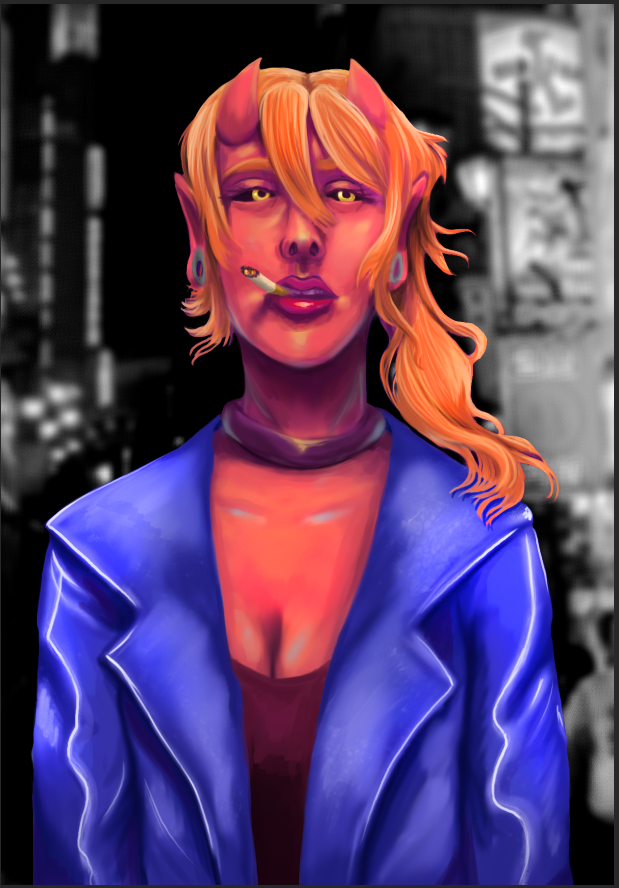
Today we'll be interviewing Amanda "TheMandii" Solano.

Kaminski: This question is pretty typical for all the creatives I come across, but what drew you into art in the first place? Was there a pivotal moment where you were like, "Holy crap, art has GOT to happen!"?


TheMandii: This question always hearkens back to my earliest memories of art. In order to keep me from making scrawling, colorful scribble masterpieces on the wall, my mother made it a point from very early on to always keep me stocked with lots of paper and coloring books to curb my urge to throw color onto everything. When you're a small child, teachers always ask what you want to be when you grow up. My answer was always "An artist. Or a rock star. Or both."

That being said, it's such a natural part of myself that I feel like I would be doing my very nature a disservice by not making this a part of my life, even in a part-time capacity. Growing up, my family wanted "more" for me, being a doctor or anything that paid well, really. I studied hard in school and did well enough, always trying to find a way that I could make money with my art so that my parents would still approve of what I was doing even if it wasn't saving lives or making new technologies and making six figures.

I think a pivotal moment for me was when I started getting scouted by colleges in high school for my portfolio and college was on the horizon and other people finally started telling me that I should do something with my art even at that level... My parents had finally accepted that for me to do anything else with my life wouldn't be right for me, so I moved forward with it from there.

Kaminski: I can somewhat relate for the need to find something extremely profitable, although my family seemed to be more akin to, "You like art, you should be a tattoo artist!" So, I guess we both share in the aspiration to at least look like a rock star, right?

Speaking of rock, what themes do you find yourself pulled to? Do you have a desire for the macabre? Sci-fi? Regardless of your personal attraction to a specific genre, why? What kinds of things ultimately keep you drawing in that genre?


TheMandii: I have very eclectic tastes, so I have a hard time sticking to just one thing. As a result, I tend to mix and match whatever suits my fancy on a given day. I'm comfortable with most genres as a result of the amount of dabbling that I do.

Right now, however, my major focus is more of an occult alt-punk BDSM vibe, I do a lot of occult imagery with religious or mythological symbolism mixed in for fun.

With that being said, I also have a deep love of fantasy art. Elves, dragons, angelic warriors, brave princes fighting an omnipotent evil - the list goes on, I love it all. The things that draw me to these genre choices usually fall in line with my love of fantasy literature as well as my musical tastes. As far as my current focus goes, it's really just another mashup of the symbols I love - skulls, death, demons, old gods of mythology, and darker themes but not quite on the level of classic horror (which I also love). My endless fascination with this myriad of topics keeps me coming back time and again.


Kaminski: Interestingly enough, it appears to me like your work would suit well on some of the more metal-esque synthwave albums that I've been seeing coming out lately. Artists like Ariel ZB would make a great contact for you to look into what the industry is looking for - if you're into that kind of thing, that is.

What kinds of experiences have you had thus far? What kind of really good experience? What kind of really bad experience? And as far as the bad one goes, what did you do to remedy the situation or what do you think you could have done to make it a positive situation?

TheMandii: So far, I've mainly done assistant or part-time freelance jobs. My first real studio experience was working as an assistant inker doing backgrounds and 'blacks' (large areas filled with black ink in comics) for an artist who's been in the biz for 40+ years. I was working at the time on DC's Flashpoint and the Archie reboot of Megaman. It was a pivotal point in my life as an artist, I learned so much about the business - the pitfalls, the joys, the techniques, so many things that I had never even considered before. The knowledge gained from my time there alone was worth every second - I remember that job very fondly.

On the flip-side (and without being too specific), in my earlier days of taking freelance work, I learned that if you don't set expectations up front, some people may try to take advantage of your time and your skills. In my case, to remedy having that happen to me, in the cases where that happened I just powered through the work and moved on, and in one case I actually bit the bullet and refunded someone in that situation. These were due to my lack of experience, and in the end was mainly my own fault for not having that knowledge.

It's a valuable lesson I learned the hard way: set those expectations, and keep yourself on the level with your client via contracts - this way everyone knows what they're getting into. It's something you can apply to all things, not just art.

Kaminski: I can definitely relate on the destruction of a project that was completely up-front because I didn't nip-it up front. That's honestly what ended up, ultimately, creating my process breakdown. I wanted to be completely transparent as to what the process is and what we'll be dealing with during the course of a project.

Knowing that you had some experience in the comics industry, is this something that you're interested in? Or do you have a specific field that you're striving for? Any specific reasons why?

TheMandii: If I were to do comics, they would be ones that I've written and drawn - other than that, I don't think I could see myself doing comics full-time as a goal. I do admire the industry greatly, but my real love lies in illustration and creating concepts for my IP. I really gravitate towards character art more than anything else, creating otherworldly people has always been my favorite thing. It allows for the idea that an alternate reality in which fantastic things like magic (for example) might be possible, even if only in fantasy. That's what draws me to that kind of art.


Kaminski: Switching gears: I know that you work a day job typically - can you share some insights into working both as an artist and as a day-to-day worker? What kinds of techniques do you have to cope with switching gears mentally? Are the two interdependent or is your day job something completely different?

TheMandii: My day job is completely different and has nothing to do with art - I work in tech during the day. With that being said, I'm very fortunate in that my current employer puts large emphasis on work-life balance. I use all of my breaks (and a huge chunk of my free time overall, outside of work) for art.

I can say though that in past experiences, my work-life balance was not, well, balanced.... My art really suffered for that despite my efforts. I definitely sympathize with people who have a hard time coming home from a rough day at a day job and no longer feel like drawing.


Honestly, the only insight I have into that is that you have to power through it if you want to get better in your craft. It's kind of a tough-love approach, but it's the truth.

Kaminski: Most people tend to forget that life feeds art and vice-versa. So if you're not having a good day, the tortured artist mentality doesn't typically work out. There was a comic by Sarah's Scribbles that talked about this exactly. 

With the mention of work-to-life balance, what's a Mandii working on these days? Do you have any specific projects you'd like to promote?

TheMandii: Mainly, my real "project" is continual self-improvement. I've been working on a lot of techniques, drills, using reference, and doing exercises and keeping on a strict schedule in order to improve my skills.

Outside of that, I have a wide variety of IP's that I have in the works-many of them I try to keep under wraps as much as possible for now. One that I will be happy to talk about is my current main labor of love. 


I have a particular character that frequents the majority of my work in the last couple years. Her name is Riley, and I am slowly releasing bits and pieces of her world. The best way I can describe it right now is 'Supernatural Cyberpunk Urban Fantasy'.

I have yet to name this project, but expect to be seeing a LOT more of it, and soon!

Kaminski: Now you're speaking my language - cyberpunk! It would appear you've been following suit by sticking to the theme, what with you sticking to a rigorous streaming schedule. What tips do you have for starting to schedule working times and play times? Do you have any recommendations for artists out there that would like to get on a schedule? Maybe you could talk a bit about the pitfalls or upsides to scheduling pretty tightly.

TheMandii: Yes, Rigorous is a good word for that! I treat my streaming times as practice time for my art most of the time, so scheduling it helps prevent me from doing things that are otherwise unproductive. The beauty of it, though, is I am not yet at the stage where I set an end time for my streams, I only stream for as long as I feel like (usually an hour or more).

Advice for other artists who want to get onto a schedule, really, is just look at your day-to-day routine and be realistic about what you spend your time on. All that time you spend on social media, vegging out in front of the TV, or just doing nothing? That could be streaming time. Of course, you want to keep time for yourself for self-care and relaxation! But, if you can spend time scrolling your social media feeds, you can spend time streaming or practicing instead.

Of course, you want to keep time for yourself for self-care and relaxation! But, if you can spend time scrolling your social media feeds, you can spend time streaming or practicing instead.

Tight schedules tend to stress people out - but it's really just a matter of discipline. Pitfalls to avoid would be to forget to schedule free time for yourself. Remember, no one is FORCING you to stick to a schedule, but your fans will come to expect consistency from you. Upsides are, you always know what you're up to!

Kaminski: Honestly, I think lots of creatives feel that obligation to be on at all times. We all tend to feel bad if we take breaks because it's not what we see from the output of major art collective websites. We get this impression that art is just constantly being pumped out, and while that may be true of some artists, we also don't talk enough about the burnout that can happen by not taking breaks. I feel it's an important thing to discuss, so I'm glad that you bring that up. 

Back on track with creating more work, what goals do you have set for yourself for the immediate? And the long term?

TheMandii: My immediate and long-term goals have been and always will be to keep improving. Aside from that, my current long-term goal is to really flesh out and build up the world of my latest IP, and perhaps to revamp some of my older ones. Whether those come in the form of art, or in writing form, you'll have to stay tuned to find out!

Kaminski: What's the best piece of advice you've received OR what's some advice you could give fellow artists?


TheMandii: The best advice I can give to other artists is that if you want to improve your skills in your chosen craft, you need to put in the time, blood, sweat, and tears into it. Push your boundaries, try new things, study! Even if those studies never see the light of day, the thing that matters is that you're practicing, always.

Kaminski: It's always a pleasure to interview someone whose artistic taste is in line with my own! Thanks for all your advice, and for volunteering to be interviewed!

----------------------------------

Thank you all for reading, I hope you enjoyed this interview with Amanda "TheMandii" Solano.
If you did, please give it a SHARE via Facebook or Twitter, below.
You can view this interview, and many more, HERE.

You can find view more of Amanda's work at her INSTAGRAM:
If you would like to be a part of my interview series, simply fill out the contact form HERE and I'll get back with you as soon as possible!

----------------------------------

THANKS FOR READING, AND UNTIL NEXT TIME!

Friday, April 20, 2018


As an artist, it seems like the landscape is ever-changing from simply the tools, to the aesthetic. I intend to be an artist that never wants to stop learning, and as such, I find more and more interesting artists every day. Each artist has a unique insight and point of view, no matter the experience level. New views help open my mind and teach me there are many ways to utilize my skills and I hope that sharing our stories will help others in the same way. I believe there are many paths on an artistic journey, and each interview will help to show the stories of the artists that tread them. 


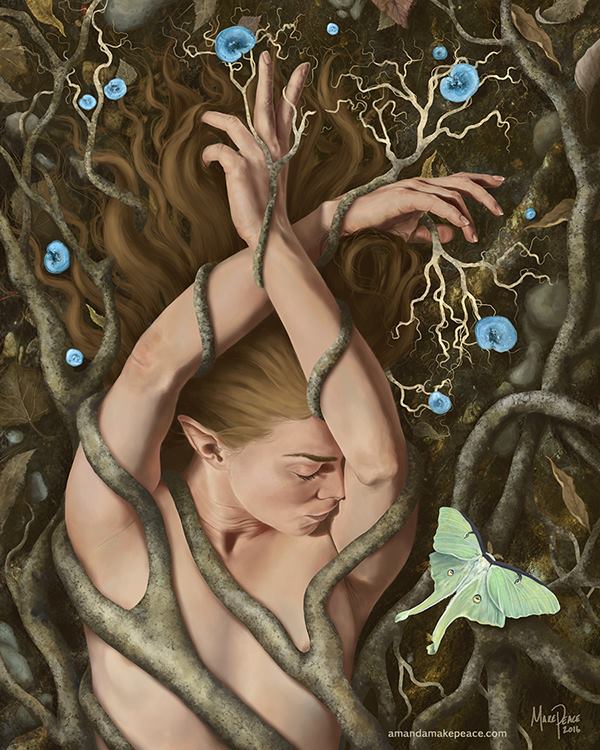
Today we'll be interviewing Amanda Makepeace.

Kaminski: First question is always the same, tell me a little about yourself. What made you pursue the tricky minefield of creativity? Is it something that you always saw yourself pursuing? What KEEPS you pursuing it?

Makepeace: I suppose I have my mother to blame for my creative passion. As a child I was surrounded by art, sculpture, and books around the house. I use to beg her to draw my toys and watched with amazement when she recreated them on paper with an ordinary pencil. By the time I was 8 years old, I was drawing all the time and essentially never stopped.

While I've always considered myself an artist, I don't know that I could have predicted I'd be a working artist, traveling around to conventions and creating book covers. I began my journey as a fine artist more than a decade ago. It's only been in the last 5 years I've turned my focus toward illustration and fantasy/scifi themes. It's been an amazing experience.


What keeps me pursuing it? I honestly can't imagine doing anything else with my life. I see art and stories everywhere. It's a joy to create them and share them.

Kaminski: Interesting! I've heard of many an artist talk about the variance between fine art and illustration.

Since you say you've been a part of both worlds, what's your take on the two? Are there any differences that you can see or do you see them as distinct branches? Do you enjoy one over the other and/or why?

Makepeace: I’m sure someone, somewhere, has written a thesis on the world of fine art and illustration. In simple terms, the main difference between the two is intent--one is narrative (illustration) and the other can be whatever it wants. One focuses on publication and the other galleries and collectors. There's a grey area between the two that overlaps and connects them. We can see that especially now, where galleries are catering to illustration themes. During my time as a fine artist, I was more focused on still life painting and nature themes. But even then, there was often a story hidden within the art. When I moved more into the world of illustration that story became less abstract.


I love both and I still create pieces that I wouldn't call illustration. The difference now being I'm less concerned with showing them in galleries. I have the control in where and how I sell them and reproduce them.

Kaminski: Yeah, there was always this upheaval during my stay in college between the two, so it's refreshing to see another person agree with me that they are more-or-less one and the same.

Switching gears: your artwork seems varies from piece-to-piece. Not just in terms of theme, but in terms of media used, size, etc. Is there one that you find preferential over the others (media-wise)? Or do you love the versatility offered? Does one media effect your output over the others?

Makepeace: I do work in a few mediums! My main mediums are graphite, watercolor and digital but there was a time I only worked traditionally in acrylics and watercolors. I have an autoimmune disorder that effects the connective tissues in my body. In 2011, it became increasingly difficult for me to paint my large acrylic paintings. It was a difficult time for me. Out of desperation to create, I began experimenting with digital painting and fractal generation. Working with a Wacom Intuos turned out to be far less strenuous on my hands and I fell in love. Digital art opened a door--it tapped into a part of my creative mind that had been dormant.

I love both traditional and digital, but my traditional work tends to be smaller in size because of my health obstacles. Digital let's me go as big as I want to print, but it's not necessarily faster. I approach digital painting far more like a traditional artist as far as process goes and use far less of the nifty tricks. However, I'm continually pulled back to traditional. I love my pencils and watercolor too much to let them go.

Being true to yourself, your art and to others will set you apart--it will make you shine.

Kaminski: With your background in traditional roles, what made you dive into the convention scene and not strictly gallery work? What effect have conventions had on your work? Are there any cons you particularly enjoy over others? And lastly, what makes them stand out over others?

Makepeace: I owe my leap to conventions to an illustrator I met at the DragonCon Art Show, who has since become a close friend. He convinced me my art would be a good fit. At the time I had only just begun my journey transitioning to fantasy and sci-fi art. I was unsure, but after my first art show the following year (at DragonCon) I was hooked. I have since had a few pieces in galleries, but I love conventions for the interaction you get with the fans. Having a chance to interact face to face with someone who loves a piece you've painted, in a truly honest way, is priceless. I've never had that with galleries.

From a business standpoint, conventions have allowed me to make more lasting relationships with those who graciously support my art. Those relationships have evolved beyond just the conventions themselves. I'm creating art not only for myself but for them as well, and it's a wonderful experience. I'm quite partial to the conventions here in the southeast but I'm planning to branch out more in the coming year.

Kaminski: Yeah, I feel you on the relationships being more meaningful - hell half of the people that I talk to currently are from people I’ve met at conventions. Social media is great and all, but there's something to be said about face-to-face.

Speaking of social media and relationships: What are some suggestions you have for promoting yourself and/or keeping yourself relevant? Do you have any particular suggestions for things that have worked for you in particular?

Makepeace: [On] social media and self-promotion... I used to spend an enormous amount of time researching ways to stay relevant and sell my art online. I still try to stay in the know, but I worry about it far less. I think the internet is flooded with art and illustration. Artists have to work ten times harder to gain any traction on social media, whereas, face-to-face interaction is instant. They either love your art and buy it, or they walk away and you greet the next person. Ultimately, if you're making connections with fans of your art at conventions and other events the best thing you can do online is stay true to yourself, interact with those fans, and keep creating and sharing art. That's the core of it. I like to think of social media as a way for my fans to stay up to date with what I'm doing till they see me again.

At the same time, you're putting art out there that may be seen by other eyes--potential clients. It's important to remember what you post online is a reflection of you and your business. Not much is truly private anymore. How you present yourself online can be a deciding factor in whether a client will hire you.

Kaminski: Do you have any project or series in particular that you'd like to throw out there - along with some of the ideas and reasonings behind them?


Makepeace: I don't tend to focus on very specific personal projects or series of works, which I know is out of line with what a lot of other artists are doing right now. That's probably a side effect of being an artist that works in multiple mediums and genres. My mind is an endless stream of ideas and visions. I've found, as long as I'm creating something I love and connect with on a deeper level, then others will connect with it too. However, there are themes and subjects that I gravitate toward and I think they can be found in almost all of my work. There are strong elements of nature/organic and magic/power that span my art, from Fantasy to Science Fiction and from my Traditional art to my Digital. These are themes I've always been pulled toward and they permeate other parts of my life too, not just my own art.


One project I would like to shamelessly promote is the Bird Whisperer Project Melissa Gay and myself launched in 2016. What began as a fun monthly challenge between the two us has grown to involve dozens of other artists. It's an open challenge to artists of all levels. The core idea behind it is to have fun and promote making art. It doesn't hurt to have a love of birds too!

I'm also participating in two group projects that are forthcoming. One is a card game being developed by the Changeling Artist Collective and another is a collaborative art book focusing on Victorian Horror. I'll be sharing art for those online in the coming months.

Kaminski: Which do you prefer more, the convention scene or the gallery scene?

Makepeace: I very much prefer the convention scene! I love being there as an artist and interacting with fans, but I also love all the fandoms too. I attended DragonCon long before I was ever an artist there.

Kaminski: Since Midsouth Con last month was my first jump into doing a convention's art show, I felt a little lost myself, even though after-the-fact I see that it's pretty self-explanatory.

What tips and tricks for solidifying your work in the art shows for conventions would you be able to toss out there? Do you find any particular method to arranging your pieces or mounting or anything seem to change the end-result of your art show? Do you find art shows to be more or less rewarding than tabling at a show?


Makepeace: Conventions are a great way to grow your fan base and sell your art but they can be intimidating when you're just getting started! They can also be a bit of a long game too. I've found that the first year at a convention is the one where everyone gets to know you and your art. When you return the second year you're a known quantity and it makes a big difference! I also suggest taking the time to be observant. Look at what other artists are doing, look at their setup, how their table is arranged, etc. and take notes. I'm not saying copy what other artists are doing, but you can learn from them and adapt things to suit you. There's a lot of trial and error involved until you find that sweet spot.

For example, my gallery setup for Art Shows is continually evolving as I find what works for me. I also change it up depending on the show. Some shows like more of my SciFi than my Fantasy. Some want it all! My table setup is still evolving too. But one thing I've found in both instances, is you need a lot of stock. You need a library of art to show. The more you have, the more rich your display/table. Also having various price points can be helpful--something for everyone.

If I could, I'd table at every show. Having a table is usually more financially rewarding, but it also lets me interact with more people too and I love being able to do that. But that won't be true for all events, especially smaller conventions. Those that are small, that have an Art Show, allow me to be involved in other ways that are rewarding too and give me the opportunity to make connections with fans and potential clients. I've found that if you stay positive and open you can often make any convention work in your favor in one way or another.

Kaminski: All great points!
I think that the niceties get lost on convention vendors sometimes.
I was at a show one time and the guy behind us was absolutely losing his mind. I'm assuming that he wasn't selling well or that the customer base wasn't reacting as well as he had hoped. That being said, I think that the crankiness was rubbing off on everything around him to the point where his entire backdrop actually fell apart, taking his framed pictures with it.
It was really sad and I bet made his show ten times worse than it could have been had he walked into it with a good mindset.

Makepeace: Yes, I know exactly what your talking about. I've even seen a few artists come onto to Facebook after a con and completely bash the event and the fans. So sad and incredibly unprofessional.

Kaminski: What drew you to birds? And also, what kinds of birds happen to be your favorite to paint / draw?

Makepeace: Uh-oh, you've opened a can of worms now...

It's rather ironic I've become so entwined with birds in recent years. I owe that very much to The Bird Whisperer Project. The truth is I'm drawn to them for the same reason I'm drawn to all wildlife. I love their beauty and their spirit. As a child, I spent a lot of time outdoors, playing in the woods, going on camping trips, riding horses, etc. Horses were actually the first animal I practiced drawing. Birds came much later! But at the core of it, there have been times in my life I've felt more connected to nature and wildlife than people and society.


That applies to birds too! I'm especially fond of Corvids (Ravens, Crows, Magpies...) and Owls, but if I had to pick one I would narrow it down to the entire Tyto genus (Barn Owls and their cousins). My latest Bird Whisperer painting features myself (as a child) and a Barn Owl. It's a painting close to my heart and definitely a favorite of mine for the moment, or until the next one!

Kaminski: That's intriguing! I think much like you I'm drawn to nature - which a lot of people might find so funny because I draw so much cyberpunk.
In my own way, that's why I try to connect that juxtaposition with the natural and unnatural.

Makepeace: Interesting!! I wouldn't have expected that. But the flip side is, I love Science Fiction too. And I'm a HUGE Alien/Aliens fan.That often surprises people too.

That's very cool! I like that idea of that juxtaposition. Glad I'm not alone in having two very different parts of me. For a long time I didn't really share that side as much. Last year was the first year I began showing my Scifi art alongside my Fantasy/Nature. And it was a hit.


Kaminski: As well it should be!
Ashley always says it's best that no matter HOW fantastical, to always root it in reality. Hell, even Neil Gaiman said such things during some of the interviews about NeverWhere.

Makepeace: Yes! I think it gives people something to relate to and that's so important in art and illustration. I'm just glad to hear that more artists aren't so cut and dry and there they are all multi-faceted

Kaminski: What goals do you have set for yourself for the immediate? And the long term?


Makepeace: After winning my first DragonCon Art Show award last summer, I wanted make an effort in 2018 to attend more events. The goal is to get my art seen by more potential fans and clients, but also to make new connections with other artists too. That means there are more expenses to tackle this year, but so far it's been worth it. I started off January at ChattaCon and won 1st Place Professional Science Fiction for my piece Saturn's Twilight. I have eight events on my calendar that I'm attending and two I'll be mailing out to for the art show. It's turning into a lesson in time management, since I also have commissions from clients and I'm continually trying to build up my portfolio.

Long term I'd like to get to a point where I'm making good profit from shows. I want to build a library of art that speaks to people. Time and persistence are my friend.

Kaminski: No doubt! You're definitely getting there though!

What's the best piece of advice you've received OR what's some advice you could give fellow artists?

Makepeace: I had to think on this one! The best advice I could any artist is be genuine. Being true to yourself, your art and to others will set you apart--it will make you shine.

Kaminski: Thanks so much for another awesome interview. It's always fun to learn about another illustrator, especially one so fond of birds, such as myself!

----------------------------------

Thank you all for reading, I hope you enjoyed this interview with Amanda Makepeace.
If you did, please give it a SHARE via Facebook or Twitter, below.
You can view this interview, and many more, HERE.

You can find view more of Amanda's work at her WEBSITE:
http://www.amandamakepeace.com/
You can also learn more about the Bird Whisperer Project HERE:
https://www.facebook.com/birdwhisperer.project/

If you would like to be a part of my interview series, simply fill out the contact form HERE and I'll get back with you as soon as possible!

----------------------------------

THANKS FOR READING, AND UNTIL NEXT TIME!

Follow Mat @artofmatk

Follow Ash @ashley.storyteller