Showing posts with label research paper. Show all posts

Sunday, May 5, 2013

Silverspun Pickups - The Royal We

Welcome back... sheesh, that was a whirlwind of crazy to get from the last update to here. I've been cranking out like crazy. I actually have quite a few pieces to update this go around plus some writing.

One more day to go (Monday) then I'm free for the summer! OH MAN! THE PLANS!

Can't start dwelling on that yet, must finish out this last day... thus I need to get my sketchbook in order.

Speaking of sketchbooks, I have sooo many pages to get onto here. 

But yeah, before all that, let me catch up my pieces thus far in the digital realm. I'll have the next couple of months to play catch-up on my sketchbooks...

Here was my final essay for contemporary novel by the way:


An Insignificant Cart 
When someone generally thinks of a cart, they tend to just think about the physical description of a cart: four wheels, metal, maybe some plastic, quite possibly an area to set a child into. In a post-apocalyptic world such as the world in The Road by Cormac McCarthy, it can become so much more than that. It was a home and an unflinching friend on top of being what it was initially: A mobile storage container. This essay is an in-depth exploration as to what the cart itself represented, the personification of the cart, and even the emotional responses gathered from the characters themselves, all while tying back into the idea that the cart could arguably be one of the most influential ‘characters’ of the book.

The cart was initially introduced as a seemingly inconspicuous grocery cart with no real description given besides that. When it was first introduced it seemed so minute, so insignificant because even this page in the story had already built up the story up with such epic grandiose. It could be argued though, that without this cart, the father and boy might not have survived very long. In a way, it was the glue that bound them to survival. Without the cart they would not have had a method of carrying the larger amounts of supplies that they had throughout the story. Quite a few times the cart seemed to come to their rescue with promises of supplies and potentially shelter. If things would have been dire enough, the man could have probably even tipped the cart over and covered it with a tarp and they would have had a makeshift shelter for at least the boy to get by in. The cart itself seemed to almost represent their very floor of survival.

The author alluded to the importance of the cart, even though it could not talk, when he wrote: “Clamped to the handle of the cart was a chrome motorcycle mirror that he used to watch the road behind them” (McCarthy, 6). The story didn't explicitly state that the cart had any other specific modifications done to it to make it more appealing to anyone else save for the supplies themselves that were burdened upon it. The second cart got stolen once but it didn't seem to complain, it was just content doing what it did best, move objects from one spot to another. Luckily each time they found a cart it was a four-wheeled cart and not a three-wheeled one (like a wheelbarrow), because the sense of stability offered by a four-wheeled cart is much better and wouldn't fall over if stopped when they had to pull the gun on the cart thief later in the story. Each time they stopped, the cart would wait there like a very well trained dog, sitting with it’s tail wagging constantly just wanting nothing more than attention.

The boy seemed to feel a sense of abandonment (more so than the father) when he and his father had to leave the cart behind and “took a last look through the basket but that was it. Let’s go, he said. The boy took one last look back at the cart and then followed him out to the road” (McCarthy, 100). In a way the cart could - at this point - be compared to a used up prostitute being left in an alley way with nothing but her panties around her ankles. It was a sad state of affairs when the cart had to be abandoned. It could be argued that in a way the father and son found this cart on the road in the same way that a person might find a drifter on the side of a long dusty desert road. They both picked it up, rode along with them, then proceeded to turn on the cart and dump it when it had used up all it’s usefulness. To add even further insult to the original cart, they find one later in the story. “There was a market at the end of the street and in one of the aisles piled with empty boxes there were three metal grocery carts. He looked them over and pulled one of them free and squatted and turned the wheels and then stood and pushed it up the aisle and back again.”(McCarthy, 150) This could be argued as the treatment of man vs. man. The personified cart is a reflection of the selfishness of mankind’s nature. They will literally use something until it is completely used up and then toss it aside without so much as a reflective thought before moving on.

Throughout this essay there was an exploration into the ‘character’ of the cart, treatment of that character throughout, and the responses that the other characters show to this cart. All-in-all Cormac’s story in The Road is a very bleak outlook on a hypothetical near future, but somehow through man’s perseverance alone, it is actually more of a story of survival and struggle. The cart in the story is not explicitly given a minor character role, but throughout the entire journey it is always there, unflinching in the face of danger. For god’s sake  if someone were to be trapped in this hypothetical future completely alone without so much as a backpack or even a pair of pants with a bunch of pockets, at the very least hope for a cart without a squeaky wheel.

Oh, right ... art!

Wood Carving: Additive Sculpture
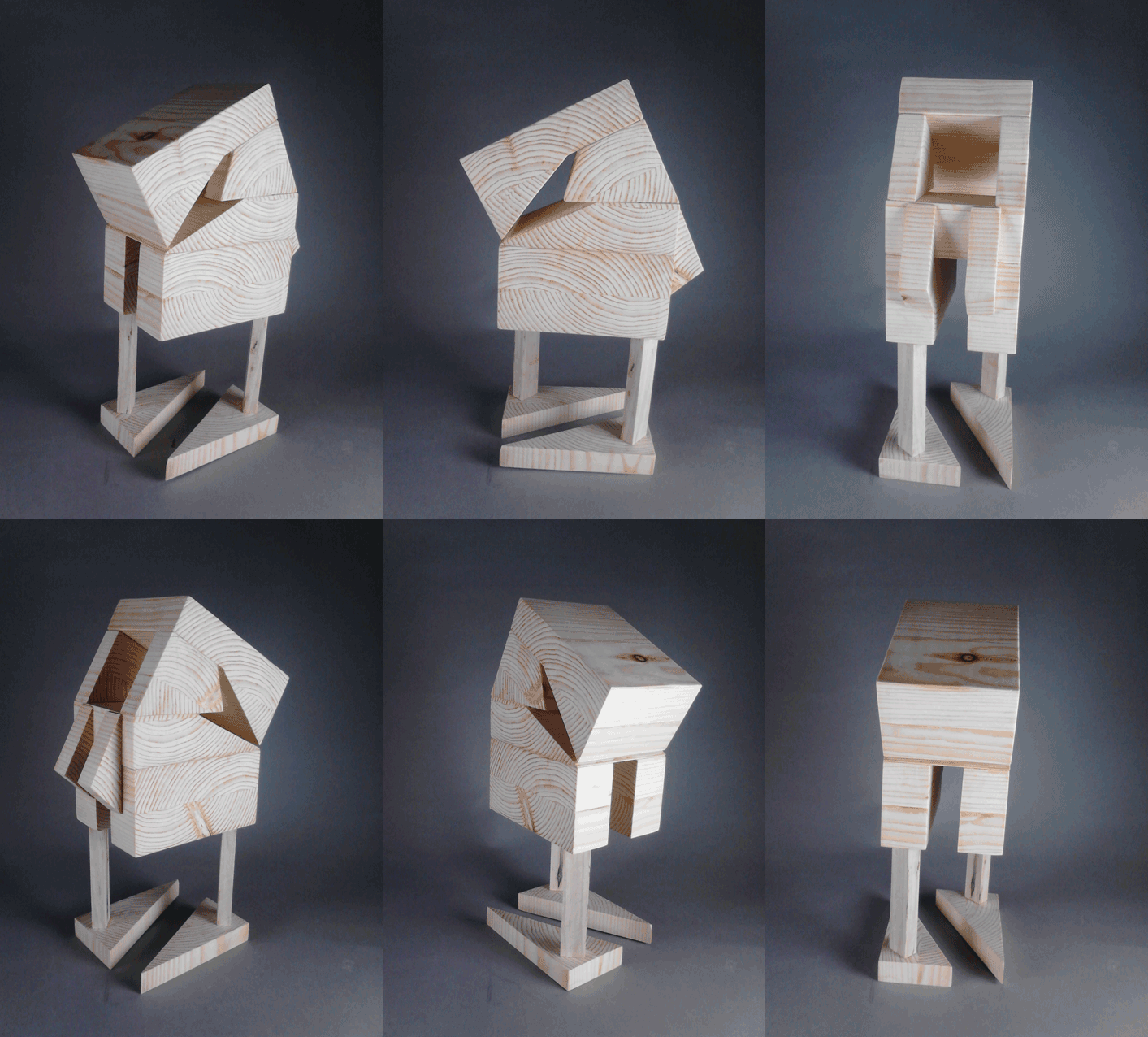

Title:  Wood Carving: Additive Sculpture
Medium: Wood Sculpture

Notes: This piece changed so many times from conception to completion. It initially started much different, but as the process went on, the puzzle pieces kept radically changing. While I enjoy the result (sort of retro robot feel), it looks nothing like the plan.
Overall, the piece deserves merit in terms of flow. I tried to make a great attempt at trying to play with the angularity as well as using the negative spaces to push the eye back into the piece.
As with the previous piece, I tried to use the patterning of the wood grain to move the eye around the piece. I almost think that having some object placed off-kilter or on the top would make for a nice break-up of the symmetry so that the piece wouldn't be so similar on each side.


Wood Carving: Subtractive Sculpture


Title:  Wood Carving: Subtractive Sculpture
Medium: Wood Sculpture

Notes: My initial thought process was to create an even more, slightly asymmetrical, organic piece. It was originally supposed to look more like a squid-like tentacle, but it ended up being more of a bird-like skull sculpture.
I decided midway through that it would be more interesting to turn the piece on it’s side and mount it slightly off-center to the wood block. I made as many attempts to follow the wood grain patterning as much as possible. I think by doing so I managed to make it even more organic. 
The problem areas seem to stem from the fact that it wasn't as smooth as I would have like it to be (especially around the “neck” area). There are so many nicks and bruises in the wood that it seems more like the piece still has a ton of work in terms of smoothing it out. Hilariously enough, I naturally threw my arm and wrist out while working on this piece

20/40 Planed Shapes


Title:  20/40 Planed Shapes
Medium: Shaped Paper

Notes:  The overall craftsmanship began moderately well, but I have since discovered that working larger tends to make things a bit clearer. I began with a much simpler design, and then realized that there weren't enough shapes to make up the overall design. I then began to place more objects in a circular pattern to mimic the exterior shape of the icosahedrons and then expanding that form at the bottom of the piece. I then took that a step further by opening the bottom of the shape to include smaller cube shapes in the interior. Since a triangular shape is the most stable shape, I decided that this would help to create a good sense of balance throughout. The shape breakup had to happen with the cubes being echoed on the outside as well.
I wish I had made the external shape at the top more load bearing because it would have helped to create a more solid viewpoint from the bottom. Also I would have liked much better craftsmanship overall, but as I stated initially, working smaller tends to be a detriment. So for next time, bigger IS better.


Dynamic Wire Sculpture


Title:  Dynamic Wire Sculpture
Medium: Shaped Wood, Wire

Notes:  For the majority of the gesture drawings, I had a tendency to draw prone animals (let’s face it, most of the animals in the zoo have become slightly apathetic). So I decided it would be ideal to find the largest animal I could find and draw it in the prone position as many times as I could before it stood up. Which led to my gesture wire frame as the bear.
My wire sculpting techniques seem to err on the slightly more gesture side instead of directly figurative. I tried to think about each of the sculpts as though I was going to 3D model the wire frame, but the output did not look as interesting as I would have liked. I tried to my best to loosen up the wire.
I could literally draw poses for days. I went to a website (www.characterdesigns.com) and attempted to gesture draw a ton of action poses. The pose that I chose was like a pre-leap pose because it gives an implied motion rather than an “in-motion” which I think might have been a bit more interesting perhaps.
For each base I tried to give a bit more dynamics to the piece by sort of tying the base to the piece. For example, with the bear piece I tried to give a sort of shale or rock texture. And for the leaping piece, I harkened back to the childish game of “don’t step on the crack or you’ll break your mother’s back” that I used to play as a kid.


Illustration II - Digital Portfolio


Title:  Illustration II - Digital Portfolio
Date: January - May 2013
Medium: Varies
Scale: Varies

Notes:  See each piece for more on the notes of each. As a whole though, this is the entirety of my illustration II class. For the most part each piece has all the work involved next to it, the only difference is that I had to truncate the amount of sketches that were with each piece.


WIP: Face that Could have been a Painting up Front


Title:  WIP: Face that Could have been a Painting up Front
Date: May 3, 2013
Medium: Photoshop

Notes:  While looking for a good reference to paint from, I stumbled upon this girl's deviant art page. She actually looks like she's painted up front, which is kind of strange, but I decided to try my hand at painting her. Unfortunately, it's still extremely stylized and the colors are kind of strange, BUT I was actually staring at Caravaggio's palette while painting this piece and tried a new technique of building up the layers. Hopefully it's starting to show some improvement, but I think I still have quite a ways to go.

Monday, January 9, 2012


Sheesh, it's been a little bit since I've posted in here. Well like I always do... I have returned. The break pretty much came and went. When it started I was all like

"YEAH! BREAK TIME! TIME TO GET MY OWN WORK DONE!" 


Psshhh..... where I did do some work, a majority of it was spent shopping for x-mas, and then promptly diving headfirst into the most relaxing XBOX 360 game-fest. When you get one of those, you pretty lose the ability to do anything but play games for a bit.

While it all was relaxing, it kind of pulled me out of the swing of what I was going to do. So during this semester of school I'm going to double time it. I have three pretty art intensive classes this go around. They should keep me pretty busy...

Anyway... enough of all that.

Time to do the old run of what we were doing before the break.

Artist of the Week! This week it goes to: Kan Muftic ! 
This guy has been on the art circuit for quite a while. His art is amazing and very well done. I can't quite decide which he does better... environments or characters. Both of them are pretty well done. Take a look at his blog and you'll be amazed!

Alright here's some of the actual work that I need to post.

Final for writing II:


The Sookie Stackhouse Novels versus the show True Blood

A Research Paper on the Sexism of Vampires
             Vampire, a single word that evokes a multitude of ways that one could interpret. The first one that comes to mind is the Hollywood theatrical vampire, in which the vampire is almost romanticized. Then, there are such forms as psychic vampirism, in which an apparition supposedly steals the  ‘essence’ of their intended victim. There are even forms of vampirism that are recognized by the medical industry. This syndrome is called “Renfeld’s Syndrome” and is characterized by periodic compulsive blood drinking and an affinity with death.[1] Many people actually think of vampirism as a mental and physical manifestation. The elongating of fangs from the incisor teeth, the supernatural abilities of flight, speed, and even the ‘glamouring’ of humans, as well as a certain ‘detached from humanity’ mentality. Each of these features seems to point to an overbearing ‘masculinity’ of what it means to be a vampire. Stop and think about it, what does each of these seem to represent? While they are to help the vampire ‘feed’, does it not seem like they are highly sexual and point towards what humans commonly portray as an emotional if not sexual rape? What follows is an exploration into what it means to be a vampire, including the fact that pop culture itself presents the vampire lore with a face of man. The fascination that humanity as a whole seems to have upon these supernatural creatures, especially when typical vampire stories are squelching the female voice, and also we are going to explore the more current fad that’s in and how it relates to sexism: The Sookie Stackhouse Novels[2] versus the show True Blood[3].
            Vampire legend dates all the way back to “[…] ancient Persia, where a vase was discovered depicting a man struggling with a huge creature which is trying to suck his blood.”[4] This goes to show that the vampire legend has existed since the dawn of man and then some, at least in an artistic sense. In the Bible itself it seems to even hint at vampirism in a certain form.
“10. What hast thou done? The voice of thy brother's blood crith unto me from the ground.
11. And now art thou cursed from the earth, which hath opened her mouth to receive thy brother's blood from thy hand;
12. When thou tillest the ground, it shall not henceforth yield unto thee her strength; a fugitive and a vagabond shalt thou be in the earth.
15. And the LORD said unto him, Therefore whosoever slayeth Cain, vengeance shall be taken on him seven fold. And the LORD set a mark on Cain, lest any finding him shall kill him.”[5]
The Bible seems to hint that Cain might have actually been the first vampire, which is why further lore suggests that the vampire is actually the “Mark of Cain”.
            The Bible itself seems to omit a bit of lore that would empower womankind as well. There is a character identified as Lilith, whom is omitted from the Holy Bible as we know it, yet is abundantly clear in Jewish apocrypha texts. This character was supposedly the first wife of Adam. Oddly enough Lilith herself is often seen as vile, as she is often portrayed as the serpent more commonly read about in the first book of the Bible, Genesis.[6] This would hint that the Bible has omitted this to very openly deduct woman’s power and actually try to vilify woman as a whole.
            Some time later, you have another Biblical character, Judas, who is also supposedly in part another contributor to the vampire legend. Supposedly by way of his evil betrayal of Jesus, he later committed suicide out of guilt. Typically vampire folklore claims “those who commit suicide are doomed to come back as vampires.”[7] Since Judas killed himself it would be only natural that based on this fact that he would return from the dead.
“3. Then Judas, which had betrayed him, when he saw that he was condemned, repented himself, and brought again the thirty pieces of silver to the chief priests and elders,
4. Saying, I have sinned in that I have betrayed the innocent blood. And they said, What is that to us? See thou to that.
5. And he cast down the pieces of silver in the temple, and departed, and went and hanged himself.”[8]
Supposedly this is also another reason as to why vampires themselves are damaged by silver. It is in stark reflection of the curse that Judas started when he betrayed Jesus, as he accepted thirty pieces of silver to ‘sell Jesus out’.
            Even before Bram Stoker popularized the legend itself, there was a countess that was nicknamed the Infamous Lady. Countess Erzsebet (Elizabeth) Bathory was considered to be one of the vilest Female Serial Killers. It is said that she is a vampire woman who slaughtered and killed well over six hundred and fifty servant girls and proceeded to bath in their blood in an attempt to gain a supernatural immortality. She went even further by “biting pieces of flesh out from the girls, but also using knives and torturing them in other ways.”[9] The story of Elizabeth Bathory actually inspired such stories as the Grimm Fairytales, and even Bram Stoker’s Dracula. It just goes to show that this legend might actually be common-knowledge for, yet again, the exclusion of women historically, albeit a poor example of woman-hood in general.
During the witch-hunts of the Inquisition there was even superstition regarding the vampire. There was a book released at that time entitled Malleus Maleficarum[10] or The Witches Hammer. The following passage was a direct response to the vampire hunting that was occurring at the time:
“It is true that both in the Greek and in the earlier Roman cults, worships often directly derived from secret and sombre sources, ancient gods, or rather demons, had their awful superstitions and their horrid rites, powers whom men dreaded but out of very terror placated; fanes men loathed but within whose shadowed portals they bent and bowed the knee perforce in trembling fear. Such deities were the Thracian Bendis, whose manifestation was heralded by the howling of her fierce black hounds, and Hecate the terrible “Queen of the realm of ghosts,” as Euripides calls her, and the vampire MORMO and the dark SUMMANUS who at midnight hurled loud thunderbolts and launched the deadly levin through the starless sky.”[11]
This goes to show that vampire superstition has existed all throughout mankind’s ages. It doesn’t stop there either; this is merely a dusting on the cake of what vampire legend goes into. Every generation in just about every country has a different take on the vampire legend.
The popularity of vampires in supernatural lore has rose and fell all throughout the generations since all the way back then. As a matter of fact, vampires have existed in every culture on the planet, ranging from Albania to Vietnam. Each country has a different name for the vampire legend and each one has a different way that the vampire itself exists and thrives. There are extremely different forms of vampires throughout the world, and some that are so bizarre that they seem more akin to creatures of nightmare and fantasy than something that would actually exist. Superstitions though, have bred these creatures and the myriad of appearances that they hold as well as their many differing ways to be killed or prevented from being created in the first place.
            In more modern times we have almost been assaulted with an overflow of the vampire. Just about everywhere in the current culture there seems to be a vampire. The series True Blood and also The Sookie Stackhouse Novels are just the tip in an iceberg of the vampires that are brought up in current times. There is a vampire in just about every type of media that we currently have, be it television shows, movies, games, art pieces, etc. Although modern vampire seems to have taken less of a mythological standpoint, and more of a romanticized, overbearing sexual presence. Even young adults seem to be exposed lately to the ideology of vampire.
Each type of media that we have at our disposal seems to take a different take on the vampire. The vampires portrayed in shows and movies have a tendency to be more sexual deviant, and violent. The vampires in books, though, tend to be viler, more like outcasts from society. Although there is a great deal of vampires throughout all of our media, there is one thing that they all share: vampires seem to be predatory creatures bent on nothing more than feeding upon and eventually snuffing out the life of humanity.
A great deal of people seems to have this overindulgent fascination with the vampire myth. The fantasy for the past few years has had a huge focus on the occult, specifically the vampire myth, so it seems only fair that the general populace would gravitate towards them. The conflict between man and supernatural seems as old as the lore itself, but the generation that we are in now seems more ‘okay’ with the gore and social dissonance represented within these stories. One could only reason then, that, especially in more current times, the vampire fascination seems rooted in three general categories: their apparent immortality, their immunity to human disease, and finally their supernatural gifts.
            Immortality is a gift that humanity has wanted since as far back as the human world could walk. It seems that we are always searching for a way to beat the clock, so-to-speak. In our search for immortality, the vampire has us beat. Each of the lore seems to point directly towards the innate immortal being that is the vampire. Since they are undead creatures, they are timeless. Time seems to have no effect on their overall appearance, and they don’t seem to gain a certain degree of sluggishness that humanity gains over time.
            In both the book and the show this gift comes at a very huge cost: the typical vampire allergy to sunlight. This unfortunate side effect to vampirism is a large price to pay for immortality. I mean imagine it, not being able to go outside or even be awake for that matter during any time that the sun is up. That would mean that in this world your time would be limited to sundown to sun-up. A small amount of people would enjoy this time frame, but think about the things that you would miss out on. The feel of the warmth of the sun comes to mind immediately. Things that typical mankind takes for granted, that can only be done in the sun, wouldn’t be even remotely accessible to vampires.
            Another serious perk that vampires seem to have over humanity is their immunity to every typical ailment that affects humans. What would a vampire need to fear from any illness that affects humans? Influenza, Streptococcus, and even AIDS seem to have no apparent effect on the vampire, at least none that have been documented in any literature. If for nothing else, humanity must have a desire for a high degree of immunity that the vampire is prone to. This could hint at the overall theme of sexually transmitted diseases in the form that the fact of vampirism seemingly being a disease itself. It’s something that is spread through the blood transfusion.
            True Blood seems to show the only evidence of any disease that affects vampire-kind. They have a form of Hepatitis called Hepatitis-D, or Hep-D, as it’s commonly called in the show. In the show it pretty much immediately turns a vampire into a human again. It strips them of all their supernatural powers and thrusts them back into humankind. It is very much like a regular human getting the flu in that it turns them bedridden and ill. The vampire is confined to sleep and is too weak to really do anything, even feed.
            Let’s not forget all the supernatural gifts that are bestowed upon the vampire kind that typical humanity does not possess. There is a great deal of lore that tells of each of the different vampire special abilities given throughout the ages upon each continent. A few such examples of these abilities are uncanny speed, animal domination, and even flight.[12] The overall consensus seems to point on the fact that vampires can manipulate humanity to their means. It is much in the way that certain animals can hypnotize their prey before attacking.
            Glamouring is the gift possessed by the vampires in True Blood and the Sookie Stackhouse Novels. This gift actually allows them to basically make anyone do anything that they want them to. It grants them the ability to basically coerce the populace into doing whatever much like a cult leader causing their followers to ‘drink the kool-aid’. Each person affected basically repeats whatever the vampire wants him or her to and then genuinely believes what he or she has been told. The interesting thing about glamouring is that it is a learned ability and not inherently given to the vampire. They must learn to do it much like a human learns to walk. It’s just something that a vampire does in this series.
            The more awkward thing about the Sookie Stackhouse Novels as well as True Blood is that the vampires contained within are completely open to the world. While humanity maintains a certain distance from them, they actually are open to the world. The line ‘coming out of the coffin’ appears a great deal of times in the series. It is actually a play on the homosexual adage ‘coming out of the closet’ in that the truth is finally known. Interestingly enough though, there is still a great deal of humans in these two that are against the vampires.
            Throughout the two series you are confronted with a group of humans called the “Fellowship of the Sun”. This group actually is very openly against the vampires and their gaining of equal rights in the American eye. The hilarious fact of this group though, is that they are no different than typical humanity as it is still falling apart because of sexism and racism. The main character that is portrayed in this group ‘Steve Newlin’ actually expresses a form of sexism towards his wife throughout the series. She is placed in a subservient role in which she plays the ‘housewife’ to the entire cult. Unfortunately in the show, she is even further exploited by the fact that she is disappointed with her husband and must now play the role of the adulterous wife by attempting to sleep with one of the newer members. While I am not here to comment on the sexual nature of womankind, I am merely stating the fact that she is placed in this role as a means to show sexual deviance from relationships and to, yet again, vilify women.
            Even vampires themselves in the show are shown in a form of sexism. One of the main female vampires throughout the show, Queen Sophie Anne, is portrayed as a powerful woman, but with complete abandon for finances. She is shown as a money hungry vampire woman hell-bent on doing everything she can to maintain her extreme fashion and lavishness that is stereotypical of a woman. At least the personality they have bestowed upon this character is atypical of feminine qualities; she is shown as extremely sexual, even going so far as to make her bisexual.
            On the vampire front, the show itself shows an extreme tendency towards sex by showing that the vampires, both male and female, are extremely sexually active. As said above, the Queen is extremely sexual, but it doesn’t stop there. Just about every vampire shown in the show has an extreme sexual appetite. The male vampires basically take advantage of every sexual situation that they can. One character even goes so far as to forcibly rape one of his clients for a great deal of hours. The terrible fact of this is that the character being raped only showed up because they were hired as a stripper in his club. It was basically an initiation of sorts.
            Luckily for vampires, at least the ‘vegetarian variety’, the Japanese invented a drink called True-Blood. This is to help stave off vampire hunger and basically give rise to the popularity of vampire-kind and inevitably led to the “Great Revelation”, or when the vampires became known to humanity. This drink is considered to be a “blood substitution” so that vampires need not go around drinking their fill on the general populace.
            Vampires throughout the many generations of mankind have been called many different things and have been given many different special abilities, but one fact still remains: vampires are generally predatory and a form of sexual misconduct. We’ve explored how historically the vampire legend has been overly dominated by the male sex, the fascination that humanity has towards this overly romanticized legend, and finally, the current fiction that many people are interested in: The Sookie Stackhouse Novels versus the show True Blood and how all of this relates to sexism. Honestly, it’s sad to say that sexism exists as a concept, but even sadder still is the fact that it is so overly prevalent in a majority of fiction and television.
Goddu, Teresa A. "Vampire Gothic." Vampire Gothic 1st ser. 11 (1999): 125-41. Print.
Harris, Charlaine. Club Dead. New York: Ace, 2003.
Institoris, Heinrich, and Heinrich Kramer, Malleus Maleficarum, Lvgdvni: Sumptibus Clavdii Bovrgeat, 1486, Translated and edited by Montague Summers, London: 1928.
Nosferatu. Dir. Friedrich W. Murnau. Perf. Max Schreck. Jofa-Atelier Berlin-Johannisthal, 1921. Film.
"True Blood: Season 3." True Blood. HBO. Television.
"Vampire - Mythical Creatures Guide." Vampire - Mythical Creatures Guide. Mythical Creatures Wiki. Web. <http://www.mythicalcreaturesguide.com/page/Vampire>.

[1] Medical Guidebook that shows this disorder. Renfeld’s Syndrome.
[2] Harris, Charlaine, Club Dead, (New York: Ace), 2003.
[3] True Blood, DVD, (2011;  .[4] http://www.vampiresamongus.com/history.html
[5] Genesis. 4:10 – 15 (The New English Bible; New Testament).
[6] http://witcombe.sbc.edu/eve-women/7evelilith.html
[7] hellhorror.
[8] Matthew. 27:3 – 5 (The New English Bible; New Testament).
[9] http://infamouslady.com/about_the_countess.html
[10] Institoris, Heinrich, and Heinrich Kramer, Malleus Maleficarum, Lvgdvni: Sumptibus Clavdii Bovrgeat, 1486, Translated and edited by Montague Summers (London: 1928).
[11] Ibid.
[12] V. is for Vampire.


And noowwww... for the ART!

Xena: Warrior Princess


Title: Xena: Warrior Princess
Date: January 3, 2012
Medium: Photoshop

Notes: I really wanted to enter this Character of the Week... damn this break was soo lazy.

The Demon Warlord


Title: The Demon Warlord
Date: January 5, 2012
Medium: Photoshop

Notes: A redesign of an old sketch that I did using Photoshop... I'm going to finish this one too!!

Sketchbook: Gestural Studies


Title: Sketchbook: Gestural Studies
Date: November - December 2011
Medium: Graphite

Notes: 6 Pages from my sketchbook final for Drawing I

Zombie Hunter Stripper


Title: Zombie Hunter Stripper
Date: January 4, 2012
Medium: Photoshop

Notes: Zombies... Strippers... Shotguns?! What have I done!

Character of the Week # 274: Prophet of the End of Times (v2)


Title: Character of the Week # 274: Prophet of the End of Times (v2)
Date: January 8, 2012
Medium: Graphite

Notes: No reference, just trying to get an idea down fast.

Sketchbook: Inks


Title: Sketchbook: Inks
Date: November - December 2011
Medium: Ink

Notes: Only 4 pages here... but this was a serious breakthrough. I've never used ink like this. Stick and ink was amazing. I want to do MANY more of these.

The Jester


Title: The Jester
Date: December 30, 2011
Medium: Photoshop

Notes: An old piece in a series of characters that I was working on... I really want to get back to this guy and the others.

Notes on History


Title: Notes on History
Date: September - December 2011
Medium: Graphite

Notes: This is every note from my art history I class in college. While this might be a bit awkward to look at, I just thought it might be interesting for some people to find the artists that I wrote in here and maybe do some Master Copies or at least have a good laugh at some of the silly facts that art history has in it. (if you want to see the original, just email me and I'll send you the original -- matkaminski@yahoo.com)

Sketchbook: Odds-n-Ends


Title: Sketchbook: Odds-n-Ends
Date: November - December 2011
Medium: Graphite / Photoshop

Notes: About 14 pages smashed together... most of this was the hand studies that I did for my animation... I need to post that!

Character of the Week # 274: Prophet of the End of Times (v1)


Title: Character of the Week # 274: Prophet of the End of Times (v1)
Date: January 6, 2012
Medium: Photoshop

Notes: First version of this contest entry. Might go with the second one though...

Sketchbook: Realism


Title: Sketchbook: Realism
Date: November - December 2011
Medium: Graphite

Notes: About 16 or so pages from my sketchbook smashed together.


Wednesday, November 30, 2011


This week's Artist of the Week! goes to Pixeltuner over on conceptart.org!
The sheer determination of this artist on top of tip-top skill I think is what makes this artist amazing. They have been updating their sketchbook (see above) almost on a daily basis. If you look at their overall volume of work it's almost unbelievable. They participate in some capacity on every Character of the Week contest that conceptart.org has had that I can see. They just keep trucking the art out over and over on a daily basis. Just keep it up Pixeltuner, your art and speed are equally impressive...

This time we're going to do something a little different, and probably not nearly as interesting... but I'm going to show everyone my research paper on Carl Gutherz.


Carl Gutherz’ Piece:
Light of the Incarnation


Art History Survey II

Professor Cardon
November 30, 2011
Carl Gutherz’ Piece:

Light of the Incarnation

             There are many modern artists that can be compared to the gothic and Neo-Classicism movement. Many more still, which can be compared to the Masters of Old. We are focusing though, on a more distinct and less recognized artist. This artist is one who was successful not only in America, but actually throughout the world as a whole. Carl Gutherz, himself, was an artist that contributed to the art scene locally in Memphis, Tennessee, with his piece entitled Light of the Incarnation[1] which was a masterpiece in both terms of technique and skill, and it’s appearance can be directly related to the historic pieces of Cimabue, Duccio, and even Bouguereau.      
            Carl Gutherz was born in Schoeftland, Switzerland in 1844.[2] Very soon after his birth, though, his family moved over to the United States of America first in Ohio, and then when the Civil War started, they ended up in Memphis, Tennessee. Shortly after the Civil War, he was discovered as an artist and was quickly whisked away to Ecole des Beaux Arts in Paris, with further studies in Munich, Brussels, and even Rome.[3]
            He was even a teacher of note during this time as he began his teaching career in St. Louis. Even going so far as to help establish the St. Louis School and Museum of Fine Arts.[4] He helped to inspire the American mural movement, as well as to help with the ceiling in the Library of Congress.
            All this time he kept going back and forth between Memphis, Tennessee, and St. Paul Minnesota, trekking on in his attempt to recreate the art of the past. He frequented Memphis’ festivals such as the annual (from 1873 - 81) Memphis Mardi Gras parade, in which he created costumes, floats, and printed material.[5] During the start of the next century he was actually commissioned by E.A. Neely to contribute to the Memphis skyline and art world by way of the beginning designs for an art museum.[6] Initially, the design began on paper as a multitude of sketches and ideas, including designs for gardens, pavilions, etc. The task fell upon Mr. Gutherz to contribute to the art world in Memphis in a way not yet realized, as Memphis, Tennessee had not even been a blip previously on the art world’s radar. The design had been an ode to the previous art worlds’ masters. While this is not what we see today in our current Brook’s Museum of Art, it laid the groundwork for the future of art in Memphis. It is here that Gutherz’ piece Light of the Incarnation hangs today.           
           The piece itself hangs at an intimidating one hundred and sixteen inches tall by seventy-seven inches wide. This specific piece was created in oil on canvas. To stand in front of this piece is intimidating as it literally takes up your entire vision. While standing in front of the piece you are confronted with a contemplation of religion and the returning of Christ. The figures presented within it are angels as well as putti. The viewer can plainly tell each of them by the wings and halo as well as the child-like figures that are shown within the piece.
            The color is a sort-of muted yellow and oranges that hint at the coming of dawn and the rejoicing of angelic beings as their savior returns. In the distance you get a hint of depth as the color itself blends into this almost burnt gray with rays of yellow hinting at the breaking of dawn in the distance. Overall the dominant color scheme of this piece is a very warm tone with inviting hints of opposite color to draw your eye. The color scheme for this piece is rather simplistic and consists primarily of a warm palette.           
            There is dramatic chiaroscuro on some of the figures presented as well as very delicate light shifts on the varying floral patterns and falling cloth. This would hint at the overall mastery of light that the artist themselves can exemplify while pursuing this piece. Gutherz himself, during the creation of this piece actually used smaller “[…] cartoons, [which were then] used to transfer the images to the canvas. These were based upon the detail sketches that were enlarged to full scale by squaring.”[7] By using this technique he was able to quickly and accurately get the characters onto the canvas and then proceed directly onto the painting. It was a way for him to not only save time, but get his idea onto the finalized canvas right-away.            The composition of the piece closely follows the ‘rule of thirds’ in that the eye doesn’t focus on the center of the image itself. The ‘landscape of angels’ leads the eyes towards the light that is emitting from the sunrays. Overall the composition is a broken type that doesn’t bore the viewer in any capacity because of the constant change in line work. If you try and follow the contours of each figure presented, the eye follows each dip and sway individually without directly being influenced by any of the specific angels within. 
         Light of the Incarnation is an almost direct ode to the religious paintings that were made so famous by the masters of old such as Cimabue, Duccio, and Bouguereau. Each seem to have a relation to this piece by their use of not only the thick halos that are presented within this piece, but each has used a similar composition in a piece. The real difference you see here that the others don’t seem to show as prevalent is in the angelic wings. It wasn’t as widely used in the times of yore.           
          Cimabue himself seemed to use similar halos in his angels with the piece Maestra[8]. If you compare the two, they both use highly regarded religious overtones as well as the use of the halos and winged angels. They use very dramatically different compositions in each as this piece seemed to have a more ‘alter-piece’ appearance to it whereas Gutherz’ piece is more of a contemplation and visual representation of religious texts themselves. The complete lack of perspective in Cimabue’s piece as well shows the very differing times that these two pieces were made. While they seem to have a very complete roster of heavenly beings, Gutherz’ piece has them in a more interactive setting where they appear to be in conversation all together perhaps contemplating the Incarnation. Whereas Cimabue’s piece seems to have them more in an individual setting and not really interacting with the audience that perceives them or each other. By comparison, you feel more disconnected with Cimabue’s than with Gutherz’.               
           Duccio’s Entry into Jerusalem[9] by comparison, does show the complete roster of heavenly beings again, including Christ himself in a more interactive way where they appear to be in complete conversation with each other. What it lacks again is the example of perspective. It merely has each character on it’s own plane rather than in a complete landscape. There is a complete lack of depth here because of this. It has a similar ‘up-down’ triangular pattern on the character groups represented so it’s easy to see the comparable composition that appears in Gutherz’ Light of the Incarnation. Perhaps he studied this piece to get a feel for his composition when he was first designing the piece.
            Finally the piece can be compared to Bougerau’s Pieta[10] in that it uses that already familiar disc-halo that we’ve seen time and time again previously. The main difference here from the previously stated pieces as that, like Gutherz’ piece, it uses the different types of ‘non-haloed’ beings and haloed to great effect. Of course it’s easy to recognize that this piece doesn’t halo each angel as well as the Christ figure, but we can still recognize that it uses a combination of the two. Also, it uses similar chiaroscuro techniques here that we see in Gutherz’. It’s very apparent that each artist has a strong focus on proper lighting, but as well as anatomical accuracy. Each can show the very gentle shades that appear in natural human flesh as well as the varying folds that are in the cloth draped around each figure. Each artist obviously studied the human body very extensively to show their expertise in painting the human body.
           It is very evident that Carl Gutherz was an artist of international renown. Gutherz added his voice to an otherwise unknown artist group growing in Memphis, Tennessee, with his piece Light of the Incarnation which should be recognized for both it’s complete expertise of technical skill and it’s relation to the previous masters Cimabue, Duccio, and Bouguereau. Gutherz came from a relatively new area to the art world that was just beginning to grow out of the ashes of the Civil War. He was internationally trained and helped to root Memphis, Tennessee as an art Mecca to the rest of the world in the future. Hopefully artists the world over will continue to study his work and keep his spirit alive as a master painter. 
Bibliography
 Bouguereau, William-Adolphe. Pieta. Oil on canvas, 1876. Dallas Museum of Fine Arts,     Dallas, TX. Cimabue. Maestra. Tempera on panel, c. 1280. Musee du Louvre, Paris, France.
Duccio. Entry into Jurusalem. Tempera on panel, 1308-11. Museo dell’Opera del Duomo, Siena, Italy.
 Gutherz, Carl. Light of the Incarnation. Oil on canvas, 1888. Memphis Brooks Museum of Art, Memphis, TN. Masler, Marilyn. “Carl Gutherz.” The Tennessee Encyclopedia of History and Culture. Tennessee Historical Society. http://tennesseeencyclopedia.net/entry.php?rec=582. 
---, ed. Carl Gutherz: Poetic and Academic Ideals. Tennessee: University Press of Mississippi, 2009. 
---. “Carl Gutherz and the Northwest Landscape.” Minnesota History Magazine, Winter, 1993. http://collections.mnhs.org/MNHistoryMagazine/articles/53/v53i08p312-322.pdf. Memphis Brooks Museum of Art. Our History.


[1] Carl Gutherz, Light of the Incarnation, oil on canvas, 1888, Memphis Brooks Museum of Art, Memphis, TN.
[2] Marilyn Masler, “Carl Gutherz”, The Tennessee Encyclopedia of History and Culture, Tennessee Historical Society, http://tennesseeencyclopedia.net/entry.php?rec=582.
[3] Ibid.
[4] Marilyn Masler, ed., Carl Gutherz: Poetic and Academic Ideals (Tennessee: University Press of Mississippi, 2009), 7.
[5] Marilyn Masler, “Carl Gutherz and the Northwest Landscape,” Minnesota History Magazine, Winter, 1993, http://collections.mnhs.org/MNHistoryMagazine/articles/53/v53i08p312-322.pdf, 314.
[6] Memphis Brooks Museum of Art, Our History, 1.
[7] Marilyn Masler, ed., Carl Gutherz: Poetic and Academic Ideals (Tennessee: University Press of Mississippi, 2009), 47.
[8] Cimabue, Maestra, Tempera on panel, c. 1280, Musee du Louvre, Paris, France.
[9] Duccio, Entry into Jurusalem  Tempera on panel, 1308-11, Museo dell’Opera del Duomo, Siena, Italy.
[10] William-Adolphe Bouguereau, Pieta, oil on canvas, 1876, Dallas Museum of Fine Arts, Dallas, TX. 
 A little different than normal, but I just wanted to show things about my school work too...

School is over in two-weeks... oh I can't wait. I've been powering down the school work as much as I can and trying desperately to cling to some personal work too.

Well, now I suppose I'll give ya what you came for... the art!


Hand Animation Test 2

Title: Hand Animation Test 2
Date: November 29, 2011
Medium: Graphite / Photoshop

Notes: Just continuing with those studies of hands for that animation... got LOADS more of them to do.


Gestural Figure


Title: Gestural Figure
Date: November 24, 2011
Medium: Photoshop

Notes: This was done as a quick gestural sketch that I wanted to add clothes to... I need to finish it, but I like the hair!


Peering Toward You


Title: Peering Toward You
Date: November 25, 2011
Medium: Photoshop

Notes: Another gestural study that I thought looked nice. Just studying more and more photos.

Homelessness


Title: Homelessness
Date: November 26, 2011
Medium: Photoshop

Notes: This was a photo study done to show the desperation that America has at the moment with the homeless.


Girl from CA


Title: Girl from CA
Date: November 27, 2011
Medium: Photoshop


Crazy Process Studies


Title: Crazy Process Studies
Date: November 22-26, 2011
Medium: Photoshop

Notes: These are all part of my work in progress for the Character of the Week on Conceptart.org.


Well... that's all for this time... visit again soon!

Follow Mat @artofmatk

Follow Ash @ashley.storyteller