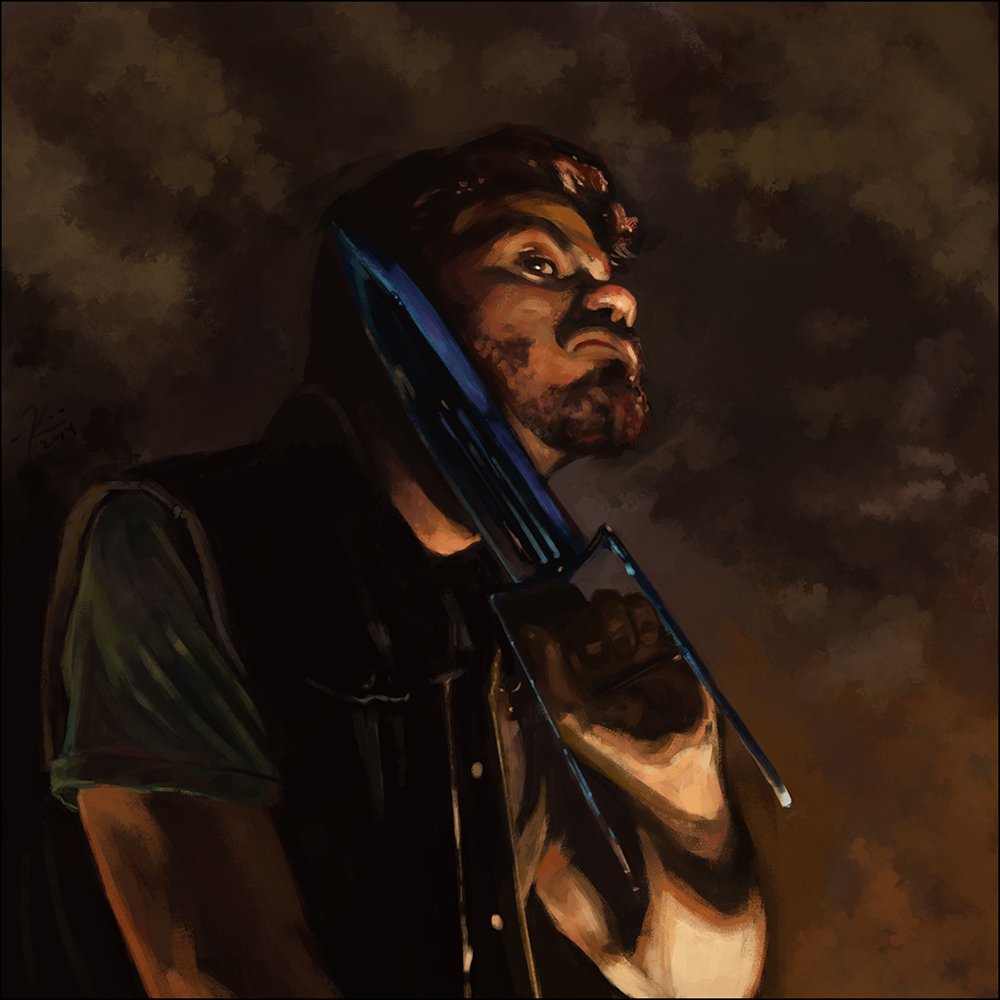
Tuesday, November 27, 2018

As an artist, it seems like the landscape is ever-changing from simply the tools, to the aesthetic. I intend to be an artist that never wants to stop learning, and as such, I find more and more interesting artists every day. Each artist has a unique insight and point of view, no matter the experience level. New views help open my mind and teach me there are many ways to utilize my skills and I hope that sharing our stories will help others in the same way. I believe there are many paths on an artistic journey, and each interview will help to show the stories of the artists that tread them.


Today we'll be interviewing Jose Alvarez.

Kaminski: My first question is typically the same: What got you into doing art in the first place and what KEEPS you doing art?

Alvarez: I started drawing when I was around six, growing up in Mexico. Astro Boy, Dragon Ball, and Saint Seiya were really popular down there in the mid 90's. I just fell in love with them, I started trying to draw the characters. I'd find pictures of them in magazines and try to trace them.

When I was in elementary, there was another kid, Luis, who was really good at drawing, and I wanted to draw just like him. So I just kept practicing and practicing. I never reached his level, but at least it gave me the push to get better.

Nowadays, I've been doing it for so long that it's just kind of a natural thing to me. I try to take breaks here and there, where I tell myself "no drawing tonight", but any time I'm idle, I reach for a pen or pencil and, by default, start drawing the planes of the face, or a shaded cube. I just love doing it.

Kaminski: This is sort of related to a question, but more a preliminary - do you find that your heritage has any influence on your work in any way? And in that vein - do you ever have the desire to draw or paint using traditional influences?

Alvarez: Culturally, I don't think so. Anime and Manga were my main inspirations, growing up, and they're not very Mexican. They were popular in Mexico, but that's about it. As far as drawing or painting using traditional influences, what do you mean? Like looking at Mexican artists, or using Mexican methods?

Kaminski: Like stylistically, using cultural icons, traditional techniques, etc.


Alvarez: Oh, yeah, I actually have. I designed an Alebrije for my daughter, and I did a very quick Day of the Dead sketch last year, I think. I don't use the motifs often, but when I was looking for a logo for my brand, I was looking at Aztec hieroglyphs. I ended up going with something else, but the thought was there.

Kaminski: Whenever you first start to approach your art for the day / project for the week / etc. what themes tend to show up first? What kind of art do you enjoy to work on the most?

Alvarez: Oh, man, that's a tough one. There's been scant few times where I pick a theme beforehand. Most of the time it's, "What should I work on tonight?". I'd say the themes that tend to show up the most are characters and figure drawing.

Kaminski: But like - fantasy? Furries? Dark cyberpunk? What is a genre you typically feel yourself drawn to? And if none - what about character archetypes: do you feel drawn towards the overbearing villainous type? Or perhaps the subversive quick-footed thief?

Alvarez: Fantasy, for sure. I try to portray every character archetype I can, because I feel like if I just did one type over and over it'd get boring, both for me and the audience. But I like the more 'fun' types. I'd sooner draw Spiderman than Batman, as an analogy.

Nothing wrong with gloom, for sure, I'd just rather draw the fun.

Kaminski: Nice! As you can see mine tend to favor the post-apocalyptic or dystopian mindset...

Alvarez: I noticed. I really liked your cyber samurai series. I could see that being a really neat world to explore. You should do something with that!

Kaminski: Since you have a penchant for the more lighthearted side of art, do you try to make it a point to target a specific type of audience? In that vein, what are some techniques you think you could talk about that you may have utilized to push towards said audience?

Alvarez: I don't really have a specific audience in mind. I like to do a bit of everything, from lighthearted sketches about children's cartoons, to more adult-oriented pieces (nothing too explicit, though). They all do mostly revolve around comics.

Lately, I've been using a technique I got from Matt Rhodes for doing quick shading. You have your base color, then your light layer on top, and your shadow layer on top of that, and you kinda use layer masks to expose the light underneath. It's real nice, and quick, and the kids love it.

(Above you'll find the video where he discusses that technique)

Kaminski: Switching gears: let's dive right into it, what's a project that you're collectively working on that you'd like to talk about / promote?


Alvarez: My comic, definitely. Ever Skyward. Fantasy action/adventure with a dash of Eldritch horror.

Currently undergoing some revisions, but you can find the most current incarnation of it over here: http://grieverjoe.ithilear.com/comic/kanu-tamu/

Kaminski: What keeps it interesting to you? Do you have coping mechanisms when you get burned out on certain parts that you use to refresh yourself to get back on the horse, so to speak?

Alvarez: It's a mishmash of all the things I enjoy, so it stays interesting. Plus, it's a good way for me to exercise my writing and storyboarding muscles. 

As far as burnout? Videogames!


To expand on that, whenever I'm feeling down or burned out, I simply take a break. I just give myself a week to not draw anything. I still look at art, and find myself doodling absent-mindedly, but I force myself to not work on any projects.

After a week, I come back and hit it again. If I'm still not feeling like it, I take a day or two more.
Bloodborne and the Witcher are two of my favorite games, and they're also big influences for it, so whenever I get burned out, I play some games. Mostly Bloodborne.

Kaminski: Oh wow! It sounds like we have identical coping strategies!
And I find it particularly interesting, what with those being on the opposite end of the spectrum than the more light-hearted subject matter that you aim for.

I don't want to have something and have people go, "Oh, that's just a copy of 'x', with a different coat of paint."

Alvarez: Precisely.

There's a lot more things that influence me, and some of them don't really mesh with each other. I try to draw inspiration from all over the place, to keep things interesting. I don't want to have something and have people go, "Oh, that's just a copy of 'x', with a different coat of paint."

Kaminski: Oh nice! Most people have a hard time with that. Blending the genres and things.

What led you to the comics industry then? What do you find so appealing about them as a creator?


Alvarez: I've had the idea for Ever Skyward in one fashion or another since around 2003 (it was very, very different than it is today, though), and always thought it would be neat to see it take form at some point. I don't consider myself good at writing, and I don't know how to animate, but I do know how to draw! So I figured, the next best thing would be to make a comic.

Plus, comics are awesome. Spawn was my favorite, growing up.

Kaminski: Have you ever thought of scouting for a writer?

Alvarez: Not really. This story is mine, so to speak. I want to tell it my way. There are other people who can write way better than I can, but this story needs to be told by me. Even if it doesn't turn out to be good, it's told by me.

That matters to me. Same with the art. There are others, more talented artists than me, but their art won't do.

Kaminski: What're your takes on social media platforms than, such as Patreon, Kickstarter, etc.? Do you have any plans to pursue these as ways to push your project to the maximum? OR do you plan on making an attempt to push it into the realm of large-company publishing?
Either way, the main question is - what's your take on the different avenues of publishing these days?

Alvarez: I think I need a finished product before I can tackle publishing. I've thought about Patreon before, but realistically, my schedule for creating is so out of whack, I wouldn't feel right asking people to support me so they can get like four updates in two weeks, and then go a month with nothing else. In the future, I think I would look at print-on-demand, but I'm just not sure. Like I said, I'd have to have a finished product, first, then have a following. Once there, I'd ask to see what the reaction would be, and maybe do small-batch printing, and later, large scale. For that, I think Kickstarter would come in handy.

But who knows!

Kaminski: Before the last two questions, do you have any questions for me?

Alvarez: Do you have any personal projects? Like, a story, or an idea for a series? It looked like you were kinda going somewhere with the cyber samurai book.

Kaminski: So, for the longest time I've been working on a large scale, dystopian world. This is where there marionettes, the vigilant, etc. all live. Eventually it will all be condensed into a multipart epoch involving the many different factions and the way of life in the wake of the disruption of the world as it is. For more glimpses into this world, look all throughout my social media presence under the tag: #honordecoded

Every marionette, every character study, pretty much most of my independent work lives in that universe. I have yet to flesh put and/or truly decipher what I've actually begun to create with Ashley (whom is the writer for the content). In time though, it will all come to the forefront.

Alvarez: I thought it looked a little too cohesive to be random sketches.
I can relate. Most of my independent work is for Ever Skyward, too.
I think if you have a central vein running through all of your work, there is an attainable goal, if even on the very long stage.

Kaminski: True. The key is to keep pushing.
What goals do you have set for the immediate for yourself? And what about long term?

Alvarez: For the immediate future, I'd say to try and keep working on my art every day. Long term would be to finish my comic. I do have some other ideas, but honestly, at the rate the comic is going, I'd be doing good to finish that one project!

Kaminski: And of course the last question... what's the best piece of advice you've ever received OR what's the best piece of advice you can give to fellow artists?


(Thumbnails for the final, above)

Alvarez: I think the best piece of advice I've gotten is to study. Study the basics, study lighting, study anatomy. Study from life, basically. It doesn't matter what you want to do. Anime, comics, cartoons... studying from life will be what kickstarts your talent. You have to learn and understand the rules before you can break them.

I was given that advice when I was around 16, and was deep into my anime and manga phase, and I dismissed it, because I wanted to draw manga, not realism! I feel that if I'd heed that advice then, I'd probably be a lot farther than I am now.

So that's what I'd say: study, kiddos!

Kaminski: Yeah, you and me both on the 'further along' bit.

In closing, it was a pleasure to catch up! Thanks for the interview my good sir!

----------------------------------

Thank you all for reading, I hope you enjoyed this interview with Jose Alvarez.
If you did, please give it a SHARE via Facebook or Twitter, below.
You can view this interview, and many more, HERE.

You can find view more of Jose Alvarez' work at:

If you would like to be a part of my interview series, simply fill out the contact form HERE and I'll get back with you as soon as possible!

----------------------------------

THANKS FOR READING, AND UNTIL NEXT TIME!

Sunday, November 25, 2018

(This is a continuation of the previous post - A Bit of Advice About: Getting Critique)


As a follow-up post about getting critiqued, I thought it just as important to point out some techniques to employ when giving critiques. I find it helpful to use some of these thoughts up front so that the person getting the critique can get the most out of it.

(Artwork: Adam Paquette)

Establish Objectives

First and foremost, what is the person getting critiqued trying to learn? I find if you don't really lay down these ground rules from the get-go, the person getting critiqued may or may not get what they want to learn out of the critique. This is not to say that you can't give an all-over or all-inclusive critique about each aspect of a piece or body of work, just that you should establish some goals to your critique. Doing this will help you keep track of your timeline, especially if you have multiple critiques back-to-back or to really help one person get the most out of your advice.

Establishing Objectives can also help narrow your focus and keep you on task just as well. It's easy for a critique, especially midway through, to start to get very conversationalist, or even attack-and-parry. I've been privy to critiques where the entire body of work was needlessly prodded at to simply make the critiquee simply go away. This is the exact opposite effect you want to achieve by the end of it. Couple this with the fact that narrowing the focus up front can help the critique from going unnecessarily long as well. Sometimes a well thought out - but brief - critique is the best approach. Going into it with a clear goal in mind for the person and then sticking only to that criteria, especially if there are multiple critiquers present is extremely effective.

Overall, it's very important to be clear and up front about what kinds of things the person getting the critique wants to gain from you, and for you to approach it as though you have something to learn from them as well.

(Artwork: Mandy Jurgens)

Leave Opinions at the Door


It's very important to realize that the critique is not meant to reflect your personal tastes or flair for a specific art style or technique. The main thing to realize when walking into a critique is to remember that you're bringing your experience to the table, be it experience in certain medias or techniques, or your skill level, or perhaps even your differing viewpoint that might change someone's outlook on a piece. This is why I find it smart to get critiques at all skill levels, from the highest pros, to the lowest level newbie. The whole point of a critique is to look at the work for what it is and not look for the outward opinion that you may personally have towards the piece.

Make sure that you use whatever objective was established (see above) and use that as your baseline to talk about the piece in that light.

(Artwork: Lizzie John)

"Attack" the Work and NOT the Creator

One thing that's always hard for many critique groups that I've been a part of is for both the person giving and receiving the critique is to remember to leave the PERSON out of it. You're looking at the body of work so that you might be able to help that person see it from a different angle, or learn a new technique. Your goal is to not go out of the way to single that person out for their specific tastes.

For example, I've been in a critique where the person at the forefront obviously had disgust for the anime aesthetic and made it very known all throughout that they were going to pick on that person for the fact that they enjoyed it. You can imagine that the end result for that person's critique, and the entire experience in general, was not favorable. They ended up in more of a rage by the end, and both parties seemed to think of each other as lesser artists, and people.

A good way that the entire situation could have been alleviated would have been to ask a question what their viewpoint is on the anime aesthetic beforehand. Maybe try their best to get into that person's head space first and then discover what they could do better to match that aesthetic. Or if you don't know anything about it, politely tell them up front that you have no knowledge of that style and see if there's something that you can help with outside of that realm. Maybe they like a certain style, but lack proper anatomy structure, or color theory, or composition techniques, etc. There are almost infinite things you can touch on, from the grand to the minute.

Of course, this can be a very difficult thing to do. Sure, there could be an artist out there of great skill that also has thoroughly studied their art history and/or has the technical knowledge to backup their viewpoints to the maximum, but again, that's outside the realm of the person giving the critique. They should try to distance their personal opinion from their critique.

(Artwork: Yue Wang)

Use the "Flip/Flop" Technique


Another technique that I've seen used effectively, I'll simply refer to as the flip/flop technique.

What this means is, for every negative quality you see in a piece, try and find something to positive to reinforce. This will help to lessen the blow of something extremely devastating like, "The anatomy simply isn't correct." You could follow that up with anything really - simply a ", but the way you paint eyes (clothes, grass, hair, etc.) is really impeccable."

This seems to not only lessen the blow of something very devastating, possibly even requiring a complete overhaul, but helps them to realize some things that they've done right! The point of this technique is to ultimately give them things that they can study after-the-fact to really blossom even further!

(Artist: Andrey Surnov)

Remember: Growth is Key


This can be true for both sides - people have this tendency to forgot, or hell even become elitist, that both sides can grow from a critique. Just because you're being asked for / are providing critiques as a service, doesn't mean that you are some higher power or anything. As a friend of mine says, "everyone poops", and this includes everyone, from the top tier all the way to the bottom rung. We're all people with specific emotions at the end of the day. This is mainly to say that if you, even as the person giving the critique, go into it with an open mind, you might learn just as much from the person you're critiquing!

Here's an example: one of my years during college, we were all gathered together, doing group critiques on certain projects. Some of the people were instantly trying to jump all over one person in particular for something minor, like that person's anatomy. Sure, it needed help, but that wasn't actually what the point of the piece was. The artist being questioned was actually after very specific composition techniques. They weren't focused on learning how the anatomy was in the piece, particularly they were trying to learn how to lead the eye. SO when you take that into consideration over the other issues, you can begin to critique that piece of work on a completely different merit than what they had originally intended.

That's the point of the story, once that other small group took the thought of anatomy and things out of their head, they actually learned some very valuable lessons about how to lead the eye, how to make effective composition and ultimately, how to stay focused on the issues that were being asked of by the individual that asked for the critique.

---------------------------

REMEMBER: This list is not all inclusive. There are a plethora of other options and suggestions to give to people who are both critiquing AND getting critiqued.

If you have any other techniques not mentioned here for either of getting or receiving a critique, I'd love to hear them below!

Until then, thanks for reading!

Tuesday, November 6, 2018


I always find it interesting to look back and think about where I've come from versus where I am now. I think it's important to self-reflect. You see, a lot of people probably don't know it, but I use the International Self-Portrait Day (ISPD) as a way of seeing what sort of progress I've made over the years. I can say that I haven't exactly followed it perfectly, but it's something that is useful to gauge. I think overall, self-portraits can be a great way to reflect in that way. After all, who better to know you... than well, YOU?

I've done quite a few self portraits over the years, at all different points in my skill, and knowledge. I think it's important to note that there's consistent growth.

JULY 2012

I'm pretty sure that there are older ones all throughout the years, but for some reason this one just so happened to be the earliest on that I could find in my archives. This might be my first real attempts playing with digital painting. I didn't know much more than the hard round brush at the time, but I don't think it really mattered. It was all about finding the forms. Searching the canvas, as it shows in my stroke economy. I was just making an attempt to make sure that I got things in their right place more than anything else.

FEBRUARY 2013

This most likely starts my exploration phase with brushes. Texture wasn't exactly something that I knew about yet, I just knew that digital painting is/was something that I wanted to conquer! 
And so I continued on...

MARCH 2013

What's really interesting is that this one might've been my first attempt at real speed paint. I just threw strokes and textures all over the place! It's a blast once you start to get the hang of how the brushes themselves react on the canvas.

JULY 2013

I would consider this to be a considerable milestone. This is the beginning of my true understanding of how both form and texture combine. It could still be cleaned up some to this day, but there's some real breakthrough that happened here. When I look back it from today, it's so strange to think back to what 2013 offered versus what I can execute now.

I remember in those days thinking about how long this took, how I could easily work faster in traditional versus digital. I would constantly question what the point of working digitally was and why I wouldn't just jump off that bandwagon and just push pencils and inks - not realizing that these two could be done in tandem. I was pretty naive in those days compared to now.


OCTOBER 2014

Before the attempts at ISPD, I was doing school assignments that started to push those boundaries of what digital painting could actually do for me. For the longest time I actually pushed against this whole 'cloud-brush-form-build-up', but now it's like my default starting a canvas piece. I just randomly throw clouds on the canvas as a way to get something, anything, on the canvas. A blank canvas is WAY more intimidating than one that has something to build upon. In a way, I look at texture applied to a canvas in the same way that I look at say... gravel or sod. They are there to be build upon. Therefore, it's up to you to push and pull as needed to tend to the garden.

APRIL 2015

This was part of a final illustration assignment for school. My teacher, Michele Noiset, gathered all of us together to find a way to channel ourselves into a single portrait. I'm a very serious person when it comes to my art, and I can almost guarantee that I have this exact look on my face while I work. It's in such stark contrast to my usual, goof-ball self. I guess we all have our serious moments, huh?

Fun fact: That logo was one that I used for the LONGEST time. Look on my InstaGram and you'll see reflections of this logo to this day. I have an affinity for both cyberpunk and 80's aesthetic, so what better way than to channel it into an aged-looking icon. Ahh the retro vibe... how I love thee.

AUGUST 2015

I could've sworn this was a lot earlier than this, but this project was insane. Somehow I got roped into doing a thirty-day challenge in which we were to draw a self portrait for every day of the month. These were so stupid fast at the time. I made sure that every one of them was before I would start working for the day, so approx. thirty to forty-five minutes each.

I can tell you, it's stupid intense, but grew my brush economy ten-fold in a very short amount of time. I think that without this exercise, I would still be a bit slower at working digitally.

NOVEMBER 2015

My first go at ISPD. I took a picture specifically for this on Halloween just a day before. My father-in-law had this badass DSLR camera, and we had all sorts of interesting lighting situtions to toy with so I decided... it was time!

NOVEMBER 2016

As you can see, I quickly dove onto ISPD's challenge. I've been doing it every year thus far since 2015. I can't tell you honestly if it began that early, but I would (and still do) use it as my skill gauge for the year.

JANUARY 2017

I really loved the painterly aesthetic that I was developing around this time - there's something about this era that I actually continually channel to this day. This is about as close as I try to get with my current paint technique as I can. I can honestly say that this was about the time that I started watching Oil Painting demos on YouTube and began to channel that vibe.

A lot of people have asked me over the years why I don't simply oil paint, since I always rant about it. Well, there are lots of reasons, time and money being the main ones, but I feel the need to channel all of the traditional techniques into my digital work - I even made that brush pack long ago that I still use to this day, with some assistance from Deharme's brush pack. These two packs combined have made for the best painterly feeling that I keep on pushing everyday.

NOVEMBER 2017

This one was definitely all about speed over anything else. I think that I had just remembered at the last minute, post-Inktober, that ISPD was a thing, so I jumped quickly, grabbed my phone, took a picture, and awwwaaayyy we go. I'm not 100% sold on the painting here as it feels very plasticy and overly digital compared to my usual work. It's not to say that I didn't find something interesting about the way I worked on this piece or even the idea behind it; I can simply say that it was a very different feeling going into this one.

NOVEMBER 2018

And then we come to this years. This year was actually the first year that I'd had access to a tablet that you could actually draw on - so I'm still trying to get used to the feeling of that. That's not anything that I can use as an excuse though, as it's important to continually keep pushing every day. I just know that I drew this one stupidly fast, and kept things very loose.

Lastly... the fact that I had to hold my table at an angle... actually skewed the image upward as I worked, so at the last minute I held it upright and just stretched the image toward the top to regain the right anatomy. Inside track notes there haha!


All of this is really to go on about the fact that I think it's important to not only self-reflect, but to also take a step back every once in awhile and really gauge where you've come and where you're going.
Just always... KEEP ON PUSHING!

Monday, October 1, 2018

As an artist, it seems like the landscape is ever-changing from simply the tools, to the aesthetic. I intend to be an artist that never wants to stop learning, and as such, I find more and more interesting artists every day. Each artist has a unique insight and point of view, no matter the experience level. New views help open my mind and teach me there are many ways to utilize my skills and I hope that sharing our stories will help others in the same way. I believe there are many paths on an artistic journey, and each interview will help to show the stories of the artists that tread them.


Today we'll be interviewing Gordon Neill.

Kaminski: My first question is typically the same, but what made you pursue art? And in that vein, what KEEPS you pursuing it?


Neill: Hi, Mathew, and first of all thanks for taking the time to interview me. I'm usually on the other side of the interview chair with my podcast.

Art, for me, has been a lifelong thing and I've always enjoyed it. I used to sit around my parents house and sketch Teenage Ninja Turtles or He-Man in the hopes that one day I could be a "cartoonist", not knowing much about the industry. My career took a sleeping pill around eighteen when i left high school and didn't really know what I wanted to do. I knew I was passionate about games and so wanted to find a career somewhere in that world. I started out in college soon after, studying journalism as I had aspirations to become a game journalist, but soon after the course started my father told me of an engineering job coming up in the railway industry that paid good money and provided a decent education.

Some time passed (well a lot actually) and I was 27; I had been working in the railway for about ten years and mostly enjoyed it, but always did some creative projects on the side. I tried to make music videos for bands I played in. In some of them I was also as drummer or vocalist. I also made album covers with Photoshop and tried my hand at running a few YouTube channels for games. Each of these projects usually fizzled out, or I came across something new and shiny so I wanted to evolve each time. I guess i never felt challenged and standing still always bored me.


(Making of God of War 3)

Just as Christmas 2010 was about to hit I was having more and more thoughts about leaving my job and pursuing some career outside of it that would make me happy. I actually began watching documentaries about art and making games - mostly Halo 3 and Gears of War and of course my favorite doc which was the Making of God of War 3. I had made up my mind. I then talked to my parents and my partner at the time and decided I was going to hand in my resignation as soon as possible. There was only one problem: I had to find a course with an art college before I could leave.

I managed to get an entry level course at a local college Forth Valley College (Shout out to Julie Parker for having faith in me). The course was very basic and I felt it wasn't 100% what I wanted to do. I worked through the years after that obtaining an NQ in Art then an NC in Art & Design and finally an HND in Visual Communication (the lecturers and staff were amazing! Shout out to Brian, Hannah, Dee, Staci, Steph and Pam).

After i finished my HND I was still hungry for more and didn't feel like I was staying true to my original vision of concept art. I looked into university's that would offer courses kind of related to the industry so i signed up for a B.SC (honors degree) in 3D animation and digital art. This course was good in the sense that it equipped me with some skills I still use today, mostly using 3D software like Maya and Substance Painter. I also learned about Axis Studios in Glasgow and found them online. During my third year, through networking events, I managed to get an internship with the Studio and helped with recruitment and admin tasks for the studio team whilst they were working on several cinematic projects. I recently graduated with honors and found myself in my first job with Red Essence Games working on Mask of Semblance. I contacted Nik about working on the game and after an art test I was offered a role as a junior artist also because of my networking skills I've been put in charge of their PR for the game.

What keeps me going really is always wanting to not let myself or my family down. My parents mean everything to me and they've afforded me so many opportunities and helped me so much along the way all I want to do is make them proud. I also want to have a sense of accomplishment in my work and my life, I would rather honestly be happy than rich and the people and artists around me always make me feel motivated and want to push forward constantly.

Kaminski: Incredible! The commitment to your education most likely shows through in your work ethic. Having multiple degrees myself, I share in the desire to constantly be pushing!

Looking through your work, your definitely portfolio driven! That being said, you touched somewhat on your journey through college and above, but what was your personal experience like? Do you have any advice either way on someone wanting to jump into the field following in your footsteps?

Neill: I definitely kinda covered this in the last question. I had training of sorts on the courses I attended, but at night I was always looking online at certain courses and other things I could do with my time. Especially when I hit university things like Learn Squared and Schoolism were really coming into their own, and of course I always looked at other artist's work on ArtStation and wondered where I was going wrong. I just really looked into things like artists Gumroad's and other tutorials I could get my hand on, plus there is already so much content online for free through YouTube!


Advice really is stuff I've now come to terms with MAKE ART THAT YOU LOVE! Honestly it's as simple as that. I looked at so many portfolios and other artists work and was always like, "If I make cool realistic sci-fi stuff like that I'm bound to get work!" But, every time I tried to be like someone else or copy their work to gain inspiration I wasn't being true to myself. What did I want to do? Where was my art going and how would I get there? These are questions I constantly asked myself during my journey. In the end, I make art that makes me excited and that makes me want to make art. When I tried to impersonate realistic stuff or photo bash I didn't feel whole and it made me not enjoy the process. I didn't want to learn or produce anything due to not enjoying it. Now I'm going back to my roots and trying to pump out daily studies from games like Hearthstone as well as working with Red Essence Games.

Kaminski: I can agree tenfold on the point of making art that you're personally invested in. Every once in awhile, to remind myself, I take on commissions that are out of my passions and I can say that they are typically not the best work that I can do, and so I return invigorated with fury on projects that I'm invested in! Part of this can sometimes bleed over into fan art work and things, but again, on IP's that I personally love. Speaking of which: what is your take on fan art as a whole? Some see it as a means of self-promotion, some see it is selling out, some see it as simple copyright infringement. Do you have any viewpoints one-way or another?


Neill: Fan art is tricky because I know I love it and have definitely made some in my time. In fact there is a Hellboy sketch on my Artstation right now. I think fan art servers its purpose of inspiring artists because, I mean, come on we are all fans right!? That's why we do this stuff! We all sat at the cinema and watched Star Wars then went home and started to sketch Yoda! Or... Maybe that was just me? Seriously though, I really believe it can be a positive force. Where it becomes a grey and shady area is attending cons making prints and selling stuff. I've done it in the past, done sketches for people of a super hero they loved or sold a print, but I actually found I had more traction or sales when I printed out my landscape paintings and sold them. I think each year at a con people see the same kinda stuff over and over so when something unique and new pops up they kinda pounce on it to be different. It's not a black or white situation and every story is different but I definitely think there isn't any harm in it because we are all fans.

Kaminski: I love your refreshing take on the subject of fan art.
Switching gears: from your experience all the way to college and before, it shows that you're so well rounded. It's amazing how you've spread yourself so thin and yet still maintain quality across the board. Do you have any advice on artists trying to pursue multiple disciplines?

I would probably advise that people start with a strong foundation in their core skill (3D or Drawing) then slowly try to move and expand from that base. 

Neill: Multiple disciplines is a tricky one because of course as a modern and up and coming artist you really need to know everything, but it also dilutes your skill set. I would probably advise that people start with a strong foundation in their core skill (3D or Drawing) then slowly try to move and expand from that base. It's tough but of course we all know modern artists need to have a multi tool set approach.

Kaminski: Related to the previous question: what's a typical schedule like for you? How do you manage to keep everything on time and in order?

Neill: In honesty, it can be a bit chaotic now with Red Essence Games taking up most of my time with PR and of course art, but I try to balance my hours between that and of course learning/personal work. I'm currently building my first game in unreal and trying to burn the midnight oil pursuing my Hearthstone challenge, part 2! The best advice I can give is trying to just do a little everyday and eventually it always adds up to an overall success, Rome wasn't built in a day!

Kaminski: I'd love to hear about any non-NDA projects that you might be in the middle of: Do you have any projects you'd like to promote?

(Mask of Semblance trailer)


Neill: My main focus at the moment is of course Mask of Semblance which was announced at PAX EAST this year with Red Essence Games, we are currently working towards Alpha build and the next version for PAX 2019 you can find more info on www.redessencegames.com or check out our trailers and game play on YouTube by searching Mask of Semblance.

Also, as always, I would love to promote Digital Artcast my online podcast where we speak to industry professionals and have just launched an online teaching episode for Cinema 4D demonstrated by Leon Tukker

Kaminski: Mask of Semblance looks beautiful, and incredibly intricate. I can only assume that there's a ton of cogs bouncing around in tandem to make that project come to life. That being said, It's so incredible that you work in the games industry - it's an industry that I would love to be fully vested in. That being said, what's it like? For someone looking from the outside in - I would love to get insight into the day-to-day of working on the industry.

Neill: Working was always a worry for me. I think working for an indie developer really takes some stress off me. When I was interning at Axis Studios in Glasgow I felt the place moved at a thousand  times normal speed and I always felt I was running to catch up. This being said it did teach me some life lessons and ideas of how you should present yourself in any company. Also, it prepped me for what it would be like in a day-to-day AAA studio. Most days at Red Essence Games I chat with my boss (Nik) on what our week's objectives are and work some PR to make sure we are getting exposure or beginning to strike deals with influencers or other people that can help our brand. As our game is 2D and hand animated it's kinda old school Disney where I work on in-betweens and cell animation. Like any job you work long hours and I'm lucky I can have the weekends off!

Kaminski: It's kind of funny, recently I've been hit with a realization about being an artist in or out of the industry. If you're working a day job, be prepared to work your ass off until you can make both jobs become one! In some ways that's something that I've been working towards myself. Speaking of, what goals do you have for the immediate? And long term?

Neill: Finishing Mask of Semblance would be great as I hear so many horror stories (especially from Nik) of working on games that never see the light of day. This wouldn't be completely true as we are an indie developer so we have free reign on what we can and can't show. I would just like to get at least one title under my belt before I take my next leap. Also in the future, maybe within two years, I would like to move into a bigger studio, whether that's with Red Essence Games doing another game or sequel or moving into another development house I've yet to see, but my overall dream would be working for Blizzard Entertainment. I think a lot of people share this dream and I mostly think it appeals to me not only because of the games they make, but the style they produce in their artwork.

Kaminski: Any push you can make, big or small will help push your name further and further out. And lastly: what's the best piece of advice you can give to upcoming artists OR what's the best piece of advice you've received this far as an artist?


Neill: One of the best pieces of advice I was given from an art friend was simple but always overlooked, "BE YOURSELF". Honestly, so many times when I was starting out I tried to imitate someones style or approach to learning or producing art instead of what I wanted to do. I've finally settled on something I feel is my representation in the world and I wanna see my goals and styles moving forward in games, movies, animations and more. Really it's just about being true to yourself and never really looking back. Each step takes you somewhere new and you should always remember that this is YOUR journey and no one else. You set your own expectations and goals and you decide when you cross the finish line.

----------------------------------

Thank you all for reading, I hope you enjoyed this interview with Gordon Neill.
If you did, please give it a SHARE via Facebook or Twitter, below.
You can view this interview, and many more, HERE.

You can find view more of Gordon Neill's work at:
You can also learn more about his interview series Digital Artcast, HERE!

If you would like to be a part of my interview series, simply fill out the contact form HERE and I'll get back with you as soon as possible!

----------------------------------

THANKS FOR READING, AND UNTIL NEXT TIME!

Thursday, August 23, 2018


As an artist, it seems like the landscape is ever-changing from simply the tools, to the aesthetic. I intend to be an artist that never wants to stop learning, and as such, I find more and more interesting artists every day. Each artist has a unique insight and point of view, no matter the experience level. New views help open my mind and teach me there are many ways to utilize my skills and I hope that sharing our stories will help others in the same way. I believe there are many paths on an artistic journey, and each interview will help to show the stories of the artists that tread them.


Today we'll be interviewing Henrik Rosenborg.

Kaminski: The first question is typically the same to get the ball rolling: What made you pursue art? Is it something that you always saw yourself pursuing? What KEEPS you pursuing it?


Rosenborg: I think originally it was when I was very young and drew and painted in school. I always had a vivid imagination and was, for that age, fairly good at putting it on paper. I think the feedback from that when I was younger helped a lot. I didn't take it very seriously though, I just drew and didn't really care about progress, which was great in a way. The real progress started happening when I was sitting in my parents' basement playing World of Warcraft, no job or anything planned for the future and I was like, "what the fuck am i doing?".

I started thinking about what to do with myself, I knew, right then and there, that a normal job wasn't for me, I wanted to be creative. So I started approaching drawing as a profession, it took maaaany years before I even knew what to do with it. Seven years ago, now, I decided I wanted to be an illustrator so I just gave it all I got. At first it was more about just working with something that was interesting. Later on it turned into a way of helping people dream for a bit, see another world, even if just for a brief moment. Why I keep doing it I think is a mix of things, partially because I've put so much into it that I don't want to back down and partially the same thing as I mentioned, to help people dream a bit.

Kaminski: When first starting out were there specific industries you'd target or were you at the 'shotgun approach' and just sending out portfolio examples everywhere to see what stuck? And in that vein, what are some stories of your first for-hire projects (without naming any specific names of course)?


Rosenborg: Well I had been an avid player of Role-Playing Games (RPGs), especially in the fantasy genre for the most part of my life, so I knew I wanted to get into that somehow. I did very soon realize that it wasn't that easy to reach the bigger names even though I thought I was awesome. I started with applying to a bunch of RPGs on the Swedish market and the first few gigs I did paid incredibly bad.

My absolute first gig was for a big company, they found me as I was painting live at a big event in Sweden, the university brought us to different events to promote the school. At first I was kind of rude to the poor guy. I was tired and hungry, but he was persistent so we ended up deciding that I'd work with them on this project they had. It didn't work out though, I was so fresh back then, I didn't know anything about working professionally. It was quite a downer at first, that I lost a big name like that just cause I had a hard time adapting to the task. I was so used to just doing my thing you know?

To answer the question I'd say at first I did try get all sorts of jobs, and I did a bunch of jobs that I really didn't enjoy. But after a while i knew I wanted to get into Trading-Card Games (TCGs) and RPGs, so that's what i've been doing lately.

Right now i'm also getting into concept art, which is new and challenging!

Kaminski: Oh how fun! I love that you're so open to change.

That being said, I definitely followed suit, initially. When I first started out I had the potential to work with a big name game company that I certainly wasn't ready for, and so I declined the task. Looking back, I kinda wish I hadn't, but only you can know what you're capable of, you know?

As I've probably gone on about far too much in other interviews, I'm a HUGE fan of the Shadowrun universe and to this day, that's what reflects my need to draw so much cyberpunk and dark fantasy. 

Rosenborg: Yeah it makes a ton of sense, I guess you're ready when you're ready. I've turned down stuff before too cause I haven't felt ready or that it wasn't my area of expertise. I like to pick up jobs that i know I can handle.

Kaminski: So then, I have to ask: What influenced your dive into game art? Was it also that you played lots of RPGs and things? Were you hoarding RPG and card games much like I was in my youth? Lastly, were there any specific artists or game worlds that ultimately drove you forward?


Rosenborg: It was definitely RPGs, magic, some Swedish RPGs, computer games, Baldur’s Gate was a big one. All of these combined, it was just so imaginative. I remember, and sometimes still do to this day, the feel that the world is gray and dull in comparison to what a fantasy setting is. I often find myself trying to find some signs of real world magic! But in the long run, I want to make my own thing. I've been working for two years or so on my own fantasy setting with some friends, it will be a table top RPG and I am super hyped about it! I've always had a hard time restraining myself, I just really want to tell everyone about everything that i've made with it so far but I'm gonna keep it until it's finished enough to be showcased. 

The artist that has had the biggest influence me from the start and still to this day is Paul Bonner, just looking at his art has given me so many things. When I first saw a piece of his I was like, "how the fuck do you do that", and so that's been my constant pursuit too. Seeing his art has also made me believe in my ideas, that my imagination can turn into something, I don't always have to adapt and fall in line with what everybody else is doing. Which has been extremely valuable. Over the years I've of course picked up on other artists whose work I just love, like: Jesper Ejsing, Even Amundsen, Alex Konstad, Mike Azevedo etc!

Kaminski: Switching gears: when you first started out, what kind of training did you have initially? Are you professionally trained or did you learn as you went? Also: What medias are you favorite and why?


Rosenborg: At first it was all pencil drawings, which I've been trying to keep sharp up until today. I like to somehow stay in touch with the traditional mediums so I draw and ink some when I have time for it. It started out with a one year art school, where we got to try EVERYTHING! Sculpture, pottery, painting, etc., etc. That's where I grew the most in a short period of time I'd say. After that, I did three years at Uni - game design and computer graphics - there was a lot of 3D so I spent most of my free time doing 2D art. At first, I really didn't study too much; I've always observed a lot while being outside or around people to try to figure things out. But to actively study, I haven't done much at all. Some life drawing and anatomy through a course last summer. I've learned most through observation and just massive amounts of work! Being keen to figure things out and occasionally using reference! Correct anatomy, light, material, etc., aren't my main focus most of the time.

If it looks cool and believable i'm content!

Kaminski: I can see that your pencil work has a heavy influence on you, especially with the amount of detail your ink work has in it. Sidebar question, but do you do Inktober yearly? Or even Month of Fear?

Rosenborg: HAHA, noo... I try to, but I can never commit!

Kaminski: Hah, I agree. Something that has worked for me in the past is to find a theme and then start poking people to join in! Of course... mine usually are some sort of blend between cyberpunk and horror, but, well...

Rosenborg: Hmmm... like sci-fi or something?

Kaminski: It'd be a little more abstract than that, but yeah, pretty much.

Something like, "Pick a genre and research some material that could be in that and then adapt that to it." This is how, oddly enough, the Robo-Junicorn theme popped up out of nowhere for a project I worked on!

As far as media and creativity goes, it's amazing how many of us go through the trials of trying everything out before we decide what works or what doesn't. It took me awhile to decide that animation and posable figure sculpting was most definitely NOT my thing.

In that vein, are there any medias that you're simply not comfortable with? Do you have any stories about a project that you started that was an absolute flop because the materials just weren't in your wheelhouse or you just kind of thought midway through 'DAMN, this just isn't working'?

Rosenborg: Hmm... not really, this whole time I've been kind of set on doing 2D. Drawing, painting etc., so I've always dealt with any professional assignment with 2D. I have had assignments in school that involved 3D and 3D-animation which are areas where I am not at all comfortable! I've always been like "If I do what i love and get good at it people will hire me for it". So I've always just kept at it with 2D, painted textures, etc. - no photo bashing. That's just what i simply love and feel comfortable with!

Kaminski: Sounds like you and I have the same mentality when it comes to painting. I'm not against using whatever you want to get the end result, but I know personally that I can't find any solace in photo bashing and using texture overlays and things. Hell, these days I barely even use the blender brush (much to some people's dismay).

Rosenborg: Same here! All these options confuse me more then help me, to be honest. I mostly use one brush and just paint really.

Kaminski: Nothing wrong with that!

Rosenborg: But like you said! I don't mind at all what others use, I can see the point in using all of it.

Kaminski: It seems like you really push your work using techniques leveled up during traditional media use.

Rosenborg: Like what, for example?

Kaminski: Your work reminds me of the illustrations that I used to see frequently in fantasy game books - like watercolor and ink and things.

 
(Henrik's piece on the LEFT, Kojima's work on the RIGHT)

Maybe the best comparison might be similar to Ayami Kojima.

Do you have any projects that aren't under any sort of NDA or anything that you'd like to promote? These can be personal, or otherwise.

Rosenborg: I'm gonna mention two projects here that I am really keen on, one personal and one for a client. First off, I'm gonna mention the monster book I am working on for a litrpg book series called Ascend Online by Luke Chmilenko. Working with Luke is incredible, he's such an easy going guy, he's written this wonderful world that you just get lost in, it's so imaginative and it has this classic fantasy feel that i love. We throw ideas back and forth, he's letting me be a part of the decision making and it's a project I work on in-between other gigs. I simply do this because I want to take my time, I want to think, I want to doodle, i want to try before settling on something. Working with a person who's down with this is incredibly inspiring and joyful.


Secondly, I'm gonna mention my own passion project Ö (Swedish letter for some flavor). It started with me being in need of a home for all the weird creatures I was sketching. I started making up stories about them, but I kept forgetting a lot of the ideas I came up with. So one day I started a word document and wrote down one sentence about each idea, just to not forgot about it. It was a whole lot of weirdness, but it felt fun and crazy, just how I like a fantasy world to be. When I had thirty-five pages of one-line ideas, I felt like I should do something with it and so I started shaping it into Ö. Today we're five people working on it and what I can tell is this: it'll be a table top RPG, it'll be post-apocalyptic high-fantasy, there'll be a lot of darkness, you'll feel small and confused a lot. It's just one of those worlds I barely understand sometimes, but has a level of complexity and madness that I personally love.

Kaminski: What goals do you have for the immediate? And long term?

(WIP shot for a current project)

Rosenborg: For now it's all about stability for me: finding a balanced life, getting routines. I've worked hard for a long time and unfortunately had a pretty major crash about a year ago that I am still recovering from! Also, to just have fun and actually have a life outside of art. I easily get obsessed and burn out so I'm still trying to find a balance!
For long-term, the biggest thing I can think of is getting the ball rolling with Ö, and of course pursue some other career goals, like I'd love to work on something Blizzard related!

Kaminski: And to see you rebound as you have? Inspiring!

Rosenborg: Thanks man! It was a grim time.

Kaminski: Those serious downs with art can be intense, I never wish them upon anyone. I actually went through one myself for the earlier half of this year.

That being said though, I don’t want to dredge that up for you as it can be hard to break that feeling.
For the most part, I like to help people through hard times such as those!

And on that note: I think, especially with the cover, that Ö looks like an incredibly rewarding project!

Rosenborg: Oh i don't mind talking about it, ever, I decided to be super open with it. I talk about it a lot. I don't think suppressing it helps at all!

Kaminski: I agree! Good to know that your in the same mindset as me. Some people feel the opposite whilst I think talking about issues really helps to get them off your chest and breaks a cycle. Kind of like a big release!

Rosenborg: Yeaah man, helps you process them! Cause I don't think that these problems ever go away so, better learn how to live with them right?

Kaminski: And lastly: what's the best piece of advice you can give to upcoming artists OR what's the best piece of advice you've received this far as an artist?

Rosenborg: For me it has always been simple: Have fun! Fun is such an endless force of motivation and energy, if you feel like you're doing something fun it's easy to keep going. That's always been the lead motivator for me at least, just painting stuff that I enjoy and eventually I started getting paid for it and now it's my full-time job. Cause I got good at what I loved doing! So: Have fun, believe in your designs but also take a hard look at your work now and then and see what can be improved. Lastly, surround yourself with great friends and grow together.

Kaminski: I love the idea of collaboration! I think all artists should jump on the bandwagon!
I have to say, your interview was great! Thanks for joining in!

----------------------------------

Thank you all for reading, I hope you enjoyed this interview with Henrik Rosenborg.
If you did, please give it a SHARE via Facebook or Twitter, below.
You can view this interview, and many more, HERE.

You can find view more of Henrik's work at:

If you would like to be a part of my interview series, simply fill out the contact form HERE and I'll get back with you as soon as possible!

----------------------------------

THANKS FOR READING, AND UNTIL NEXT TIME!

Follow Mat @artofmatk

Follow Ash @ashley.storyteller